


Is Carpentry a Good Career
3min read
|
Apr 30, 2026
Is carpentry a good career?
It can be a good career, depending on what you want from your work life. Carpentry is a skilled trade that combines physical labor, hands-on problem solving, and long-term career growth potential.
For some people, it’s a practical way to earn a stable income without a college degree. For others, the physical demands and job variability make it less attractive.

Carpenter Job Description
Carpenters work on building, repairing, and installing wooden structures and components.
Typical tasks include:
- Framing buildings and structural work
- Installing doors, windows, and fixtures
- Working on residential homes or commercial construction sites
- Reading blueprints and following project plans
- Measuring, cutting, and assembling materials on-site
In simple terms, a carpenter’s job is mostly hands-on work done in real construction environments, not in an office.
Pros of being a carpenter
There are several reasons people choose carpentry as a career:
- No college degree required
- Relatively fast entry into the workforce
- Strong demand in the construction and home repair industries
- Opportunity to develop a valuable hands-on skill
- Clear path to becoming independent or self-employed over time
For many, carpentry is a way to build a long-term career starting from practical experience rather than formal education.
Cons of being a carpenter
Carpentry also comes with challenges:
- Physically demanding work that can be tiring over time
- Exposure to weather and changing job site conditions
- Income can be inconsistent at the beginning
- Skills take time and repetition to develop
It’s important to understand that this is a trade where experience directly affects comfort, speed, and earning potential.
Income Expectations
According to the U.S. Bureau of Labor Statistics (BLS), the median annual wage for carpenters in the United States was about $59,310 per year ($28.51 per hour) as of 2024.
However, actual earnings vary depending on experience, location, and specialization:
- Entry-level carpenters typically earn less
- Experienced carpenters and specialists can earn significantly more
- Self-employed carpenters may earn higher income, but it is less predictable
In general, carpentry income increases steadily with skill level and years of experience.
Career Growth Path
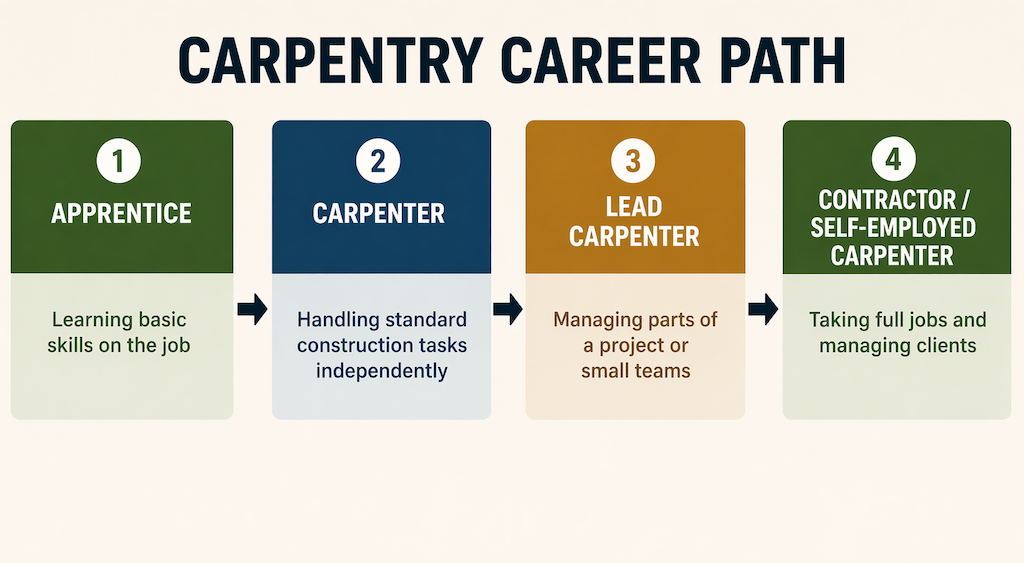
A typical carpentry career path looks like this:
- Apprentice → learning basic skills on the job
- Carpenter → handling standard construction tasks independently
- Lead Carpenter → managing parts of a project or small teams
- Contractor / Self-employed carpenter → taking full jobs and managing clients
Some carpenters also choose to specialize in areas like framing, finishing, cabinetry, or renovation work.
Is Carpentry a Good Fit for You
Carpentry is a good fit if you:
- Prefer hands-on, physical work
- Don’t want a traditional office job
- Enjoy building and practical problem solving
- Are willing to learn through experience
It may not be the right fit if you prefer:
- Predictable, low-physical-demand work
- Highly structured office environments
- Fast and easy career progression without skill development
Conclusion
Carpentry can be a strong and stable career choice for the right person.
It offers practical skills, steady demand, and long-term growth potential, especially for those willing to build experience over time. However, it also requires physical effort and patience to develop real expertise.
Ultimately, whether carpentry is a good career depends less on the job itself and more on whether it matches your lifestyle and long-term goals.
Most Popular Pages



Try Invoice Zip Today
Start Sending Invoices, Building Reports, Saving Office
Time and Get Paid Faster.