


What is Invoice Number and How to Number Invoices
3min read
|
May 20, 2026
Invoice numbering seems simple — until you actually have to decide how to do it.
Do you restart from 001 for every client?
Use different numbers for each project?
Or keep everything in one running list?
Many freelancers and small business owners end up overthinking this. And the more rules you add, the harder it becomes to manage.
In reality, invoice numbers don’t need to be smart — they just need to be simple and consistent.
What is an Invoice Number
An invoice number is a unique identifier assigned to each invoice. It helps you keep track of invoices, payments, and records without confusion.
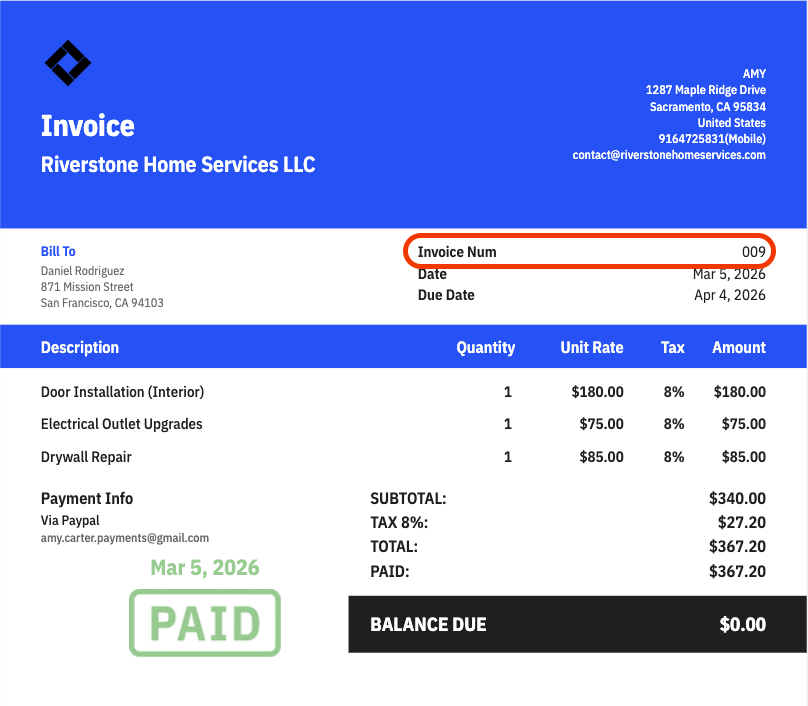
Why do you need an invoice number
Invoice numbers are used to:
- Keep your invoices organized
- Track payments and outstanding balances
- Avoid confusion between different invoices
- Make it easier to reference a specific invoice later
For small businesses and freelancers, this is especially important as the number of clients and jobs grows.
How to Number Invoices
There’s no single required format. The best system is one that is simple, consistent, and easy to maintain.
Here are a few common ways small businesses and freelancers create invoice numbers:
Sequential numbers (most common)
- 001, 002, 003…
This is the simplest and most widely used method.
✔ Easy to manage
✔ No confusion
✔ Works for any type of business
Best for: freelancers, small contractors, solo businesses
Prefix + number
- INV-001, INV-002…
You can add a short prefix like “INV” to make it clear it’s an invoice.
✔ Still simple
✔ Slightly more organized
✔ Easy to scale
Date-based numbering
- 2024-001, 2024-002, or: 202404-001…
This includes a year or date to help group invoices over time.
It can be useful for tracking invoices by year and helps with basic organization, but it’s best to keep the format simple rather than over-formatting dates.
Client-based prefix (Optional)
- CL001-001, CL002-001…
This adds a client code before the number. While it can help identify clients quickly, it may become complicated if not managed carefully and is usually unnecessary for most small businesses.
Common invoice numbering mistakes
Many people overcomplicate invoice numbering. Here are the most common mistakes:
Restarting numbers for each client or project
Using separate sequences like:
- CLIENTA-001, CLIENTB-001…
This can quickly create confusion and duplicates.
Adding too much information into the number
Trying to include:
- client name
- project name
- date
- job type
Example: CLIENTA-2024-WEB-001
This makes the system harder to manage without real benefit.
Inconsistent formats
Switching between formats like:
- 001 → INV-002 → 2024-003
This breaks organization and makes tracking harder.
Duplicate invoice numbers
Reusing the same number for different invoices can cause serious confusion in records and payments.
Most Popular Pages



Try Invoice Zip Today
Start Sending Invoices, Building Reports, Saving Office
Time and Get Paid Faster.