


How to Bill Items to Get Paid Faster
4min read
|
Jun 26, 2026
Payment terms and reminders aren't the only factors that affect how fast you get paid.
A well-structured invoice can be just as important.
When billing items are vague, customers may need additional clarification before approving payment. Clear and detailed line items reduce confusion, speed up approvals, and help invoices move through the payment process more smoothly.
Structure Invoices to Make Payments Easier
Separate Labor and Materials
A practical way to make invoices easier to review is to separate labor costs and material costs.
Taking a kitchen renovation project as an example:
Instead of:
- Kitchen Remodel: $3,500
Use:
- Labor – Installation (20 hrs): $2,400
- Cabinets and Hardware: $850
- Disposal Fee: $250
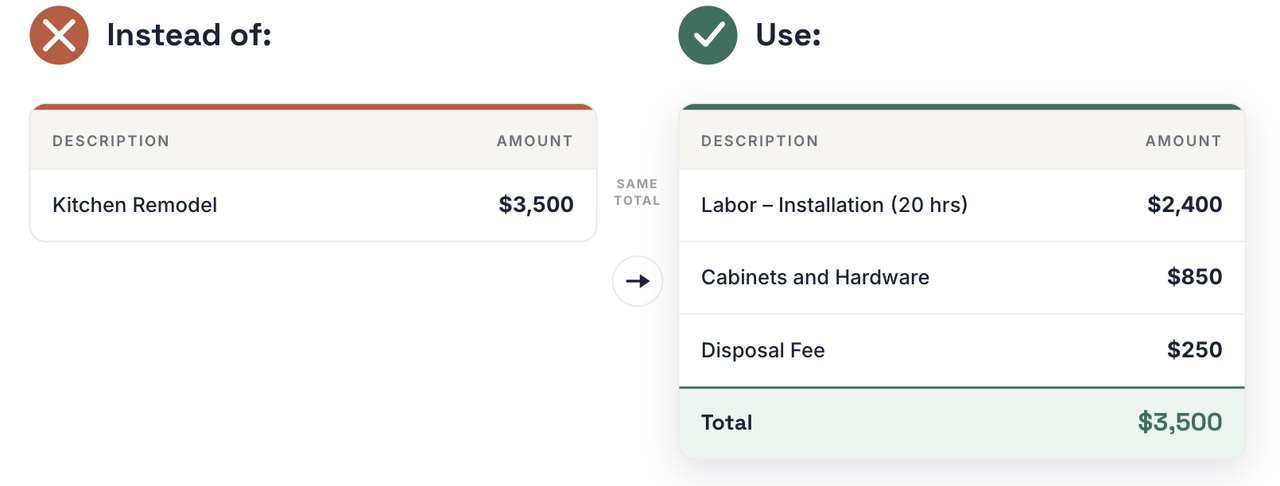
Breaking charges into separate line items gives customers a clearer view of how the total is calculated. This makes the breakdown much easier to understand at a glance.
This reduces follow-up questions and speeds up approval. When customers can easily understand what they're paying for, invoices are more likely to be approved quickly.
Make Billing Items Specific
Generic billing descriptions can make clients hesitate, and even small doubts can delay payment. A 2024 UK government-commissioned study by the Department for Business and Trade found that businesses cited administrative errors (36%), billing item ambiguity (31%), and technical issues such as lost or undelivered invoices (23%) as key reasons for late payments. Around a third of delays stem directly from customers being unsure whether an invoice is correct, highlighting a gap created by vague billing descriptions.
This is why detail matters. Vague labels leave too much room for interpretation, while specific descriptions reduce ambiguity and make invoices easier to process and approve.
Taking an HVAC (Heating, Ventilation, and Air Conditioning) maintenance work order as an example:
Avoid:
- Service Work
- Repair
- Labor
- Materials
Instead use:
- Electrical Panel Upgrade
- Interior Wall Painting – 450 sq ft
- Emergency Plumbing Repair
- Pressure Washing – Driveway
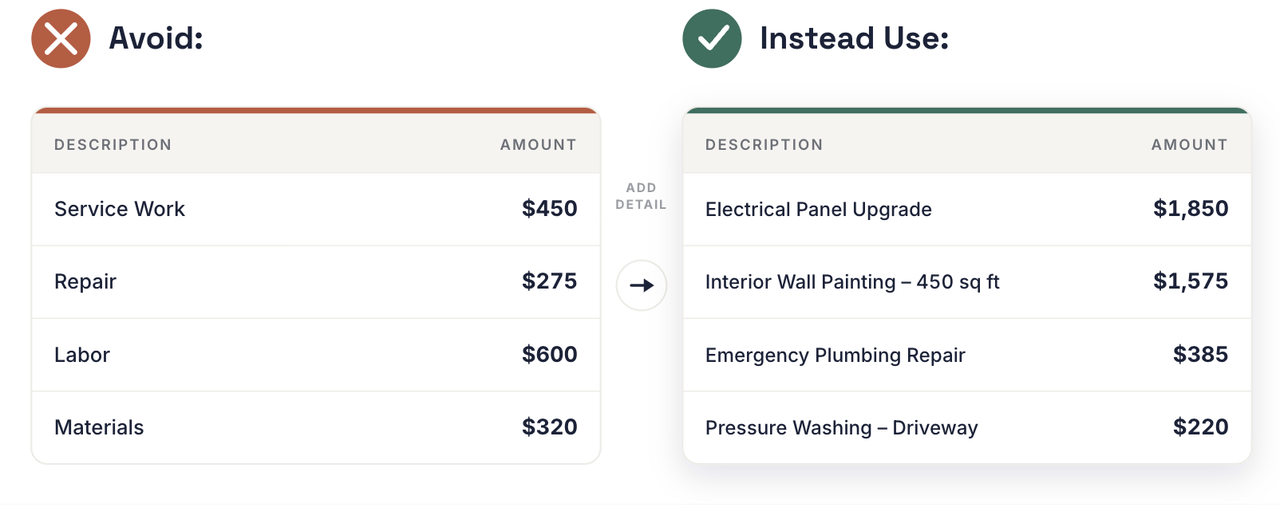
These specific billing items provide clear context and make it easier for customers to process charges without follow-up questions.
Group Related Charges Logically
Even detailed billing items can become difficult to review when they are presented in a random order.
To improve readability and reduce review effort, a more effective approach is to group related charges into clear categories. For example, in a typical HVAC (Heating, Ventilation, and Air Conditioning) maintenance work order, customers can quickly understand how costs are distributed across labor, materials, and additional fees instead of scanning a mixed list.
Labor
- Installation Labor
- Cleanup Labor
Materials
- PVC Pipe
- Connectors
- Sealant
Additional Fees
- Permit Fee
- Disposal Fee
The Tradeoff Behind Detailed Billing
Detailed Billing Improves Clarity, but Increases Preparation Effort
While detailed billing items can help invoices get approved faster, creating them manually can become repetitive.
Many small business owners end up entering the same information repeatedly:
- Service descriptions
- Material names
- Pricing information
For businesses sending invoices regularly, these repetitions quickly add up. What feels like a few extra minutes per invoice can become hours of administrative work over time.
The challenge isn't creating detailed billing items—it's avoiding having to recreate them every time.
Reusable Billing Items as a Scalable Approach
Use Reusable Billing Items
Instead of creating line items from scratch every time, frequently used services and materials can be saved as reusable billing items.
Examples:
Labor Items
- Standard Installation Labor
- Consultation Fee
- Emergency Service Call
Material Items
- Concrete Mix
- PVC Pipe
- Paint Supplies
When creating a new invoice, these saved items can be inserted directly instead of re-entering the same information. This improves consistency in both descriptions and pricing while significantly reducing preparation time.
Over time, even a few minutes saved per invoice can add up to hours of administrative work avoided.
Faster Invoice Generation and Fewer Manual Steps
Businesses that maintain structured billing item libraries often spend less time preparing invoices because they reduce the need for repetitive data entry. According to research from APQC (American Productivity & Quality Center), organizations that rely more heavily on automated and electronic invoicing processes achieve significantly better efficiency than those using manual invoicing methods. APQC's benchmarking data also shows that manual keying remains a major source of inefficiency in invoice processing workflows.
The time savings come from:
- Less repetitive typing
- Consistent pricing across invoices
- Fewer billing mistakes
- Faster invoice generation
Instead of rebuilding invoices from scratch each time, businesses can save frequently used services, materials, and rates as reusable billing items. When creating a new invoice, they simply select the appropriate items and quantities, reducing administrative work while maintaining accuracy.
The result is simple: less time spent on paperwork, more time spent serving customers, completing jobs, and growing the business.
Conclusion
Getting paid faster starts long before a payment reminder is sent.
How billing items are structured has a direct impact on how quickly invoices move through the approval process. Clear, detailed billing items reduce confusion, improve transparency, and make invoices easier to review.
By separating labor and materials, using specific descriptions, and reusing billing items, invoices become faster to prepare, easier to approve, and more likely to get paid on time.
Most Popular Pages


Try Invoice Zip Today
Start Sending Invoices, Building Reports, Saving Office
Time and Get Paid Faster.