


Small Business Cash Flow Problems: Data from Real Discussions
5min read
|
Jun 10, 2026
Running a small business is hard. Even when sales are coming in, many owners struggle to keep cash flowing smoothly. Unpredictable income, unexpected expenses, and dependency on a few clients can quickly turn a profitable month into a stressful one.
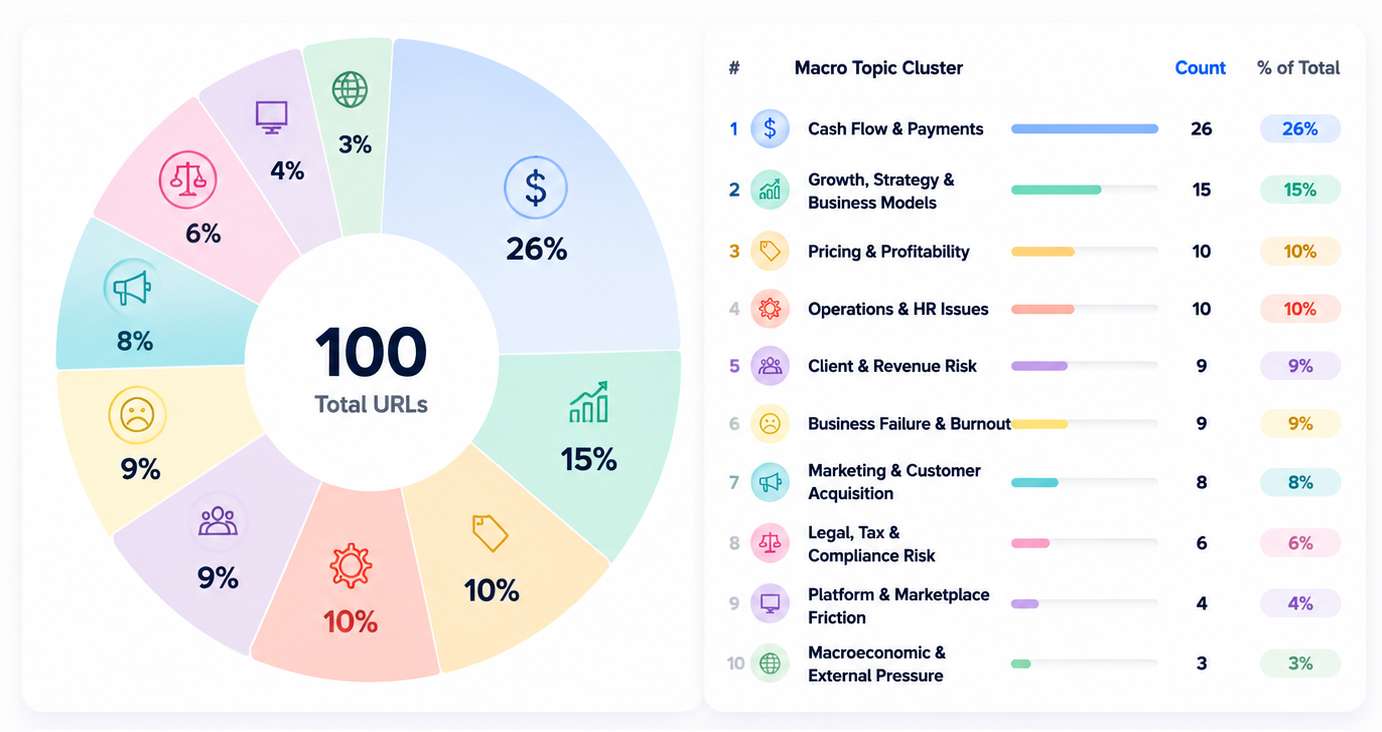
We analyzed the top 100 most popular posts in Reddit’s r/smallbusiness community in 2026, as of June 3rd, to see what challenges small business owners discuss most. Cash Flow & Payments dominates the conversation, with 26 posts highlighting issues like unpredictable income, late client payments, and fluctuating expenses—making it by far the most frequently discussed topic. Other themes appear less often, including Growth, Strategy & Business Models (15 posts), Pricing & Profitability (10), Operations & HR Issues (10), and smaller clusters such as Client & Revenue Risk, Marketing, and Compliance. This distribution underscores that, above all, maintaining smooth cash flow is the central struggle for small business owners.
This analysis is based on publicly available discussions on Reddit’s r/smallbusiness community. Individual users are not identified, and their content is used for research and insight purposes only.
Causes of Cash Flow Problems for Small Businesses
Looking more closely at the 26 cash flow–related discussions, we found that the specific situations varied widely—from chargebacks and late payments to rising costs and lost clients. However, the underlying pattern was remarkably consistent.
| Category | Count | Share (%) |
|---|---|---|
| Payment & Collection | 7 | ~27% |
| Revenue Decline | 6 | ~23% |
| Cash Predictability / Reserve | 6 | ~23% |
| Costs & Fees | 4 | ~15% |
| Unexpected Loss | 3 | ~12% |
Although these situations look very different on the surface, they all create the same problem: money is not moving when it's expected to. In other words, cash flow stress is often caused by losing control over the timing of money moving in and out of the business.
Specifically, the challenges can be categorized into three main types:
Money Comes In Too Late
Many cash flow problems begin when expected payments fail to arrive on time. Clients may delay payment for weeks, invoices can go unpaid, or completed transactions may be reversed through chargebacks, refunds, or payment disputes. Even when a business is profitable on paper, delayed cash inflows can create immediate pressure on day-to-day operations. When money arrives later than expected, owners are often forced to cover payroll, bills, and other obligations out of pocket while waiting to get paid.
Money Goes Out Too Fast
While revenue can be unpredictable, many business expenses follow a fixed schedule. Payroll must be paid, suppliers expect payment, rent is due every month, and taxes cannot be postponed indefinitely. Fuel costs, software subscriptions, and other operating expenses continue regardless of whether customers have paid their invoices. When cash leaves the business faster than it arrives, even a healthy sales pipeline may not be enough to prevent short-term cash flow shortages.
There's No Cushion When Things Go Wrong
Unexpected events are a normal part of running a small business. A major client may leave, demand may slow during certain seasons, equipment may be stolen, or an unplanned expense may suddenly appear. None of these events necessarily threaten a profitable business in the long run, but they can create immediate cash flow stress if there is no financial cushion in place. Without adequate reserves, even temporary disruptions can quickly turn into operational challenges.
The Key to Solving Cash Flow Problems: Managing Timing
The core of cash flow problems is not profitability, but the mismatch in timing between when money is expected and when it actually moves.
Addressing cash flow issues effectively means establishing a system that manages timing. This can be broken down into three practical levers: accelerating inflows, delaying outflows, and building buffers to absorb timing gaps.
Speed of Cash In
The faster cash reaches your bank account, the less likely you are to experience a timing gap between completed work and available funds. Many businesses focus on generating more sales, but improving payment speed often delivers a faster impact on cash flow.
Collect in advance
- 30%–100% deposit (critical for stability)
- Prepayment for first-time clients
- Subscription billing (pay upfront, receive service later)
Shorten payment terms
- Net 30 → Net 7 or Net 15
- Invoice due dates set to 7–15 days
- Automated reminders (T+1, T+3, T+7)
Reduce payment friction
- ACH / card payments over checks or wires
- Automatic payment setup
- Minimize manual approval steps
Speed of Cash Out
Not every expense can be reduced, but many can be rescheduled. Creating flexibility in when cash leaves the business can significantly reduce short-term cash flow pressure.
Extend payment cycles
- Vendor terms: Net 30 → Net 60
- Monthly billing instead of upfront annual payments
- Stagger contractor payments
Reduce fixed costs
- Use contractors instead of full-time employees
- Switch to usage-based SaaS instead of fixed subscriptions
- Variable cost models instead of rigid fixed costs
Batch payments
- Consolidate weekly instead of daily payments
- Combine vendor payments to simplify cash outflow timing
Buffer Capacity
Even well-managed businesses experience delays, slow seasons, and unexpected expenses. A buffer exists to absorb these disruptions before they become operational problems.
Cash reserves
- Maintain 3–6 months of operating runway
- Separate operating vs reserve accounts
Credit buffers
- Line of credit (LOC)
- Invoice financing
- Short-term working capital loans
Forecasting mechanisms (simple but essential)
- Rolling 13-week cash flow forecast
- Worst/base/best scenario planning
- Weekly updates rather than monthly
Final Thoughts
Cash flow stability is determined by how long a business can survive when inflows and outflows fall out of sync.
A business can be profitable and still run into cash flow problems. What matters is not just how much money is earned, but when it arrives and how long the business can operate before it does. The businesses that navigate cash flow successfully are often the ones that actively manage timing—speeding up collections, controlling spending schedules, and maintaining enough reserves to absorb inevitable gaps.
Most Popular Pages

Try Invoice Zip Today
Start Sending Invoices, Building Reports, Saving Office
Time and Get Paid Faster.