


Late Fee Calculator
Calculate late fees quickly with our free Late Fee Calculator. Enter the overdue invoice amount, late fee rate, and number of days or months overdue to estimate the late payment charge and updated amount due.
Late fees are charges that may be applied when a customer does not pay an invoice by its due date. Businesses may use a flat fee, percentage-based fee, or recurring charge depending on their payment terms.
Before charging a late fee, check the payment terms agreed with your customer and any applicable laws or regulations.
The amount and type of late fee you can charge may vary depending on the transaction and location.
Late Fee Rates and Types
The calculation depends on how your late fee is structured. The most common methods use a percentage of the unpaid invoice balance, a fixed amount, or a rate that accumulates over time.
Percentage-Based Late Fee
A percentage-based late fee is calculated by multiplying the overdue invoice amount by the applicable fee rate.
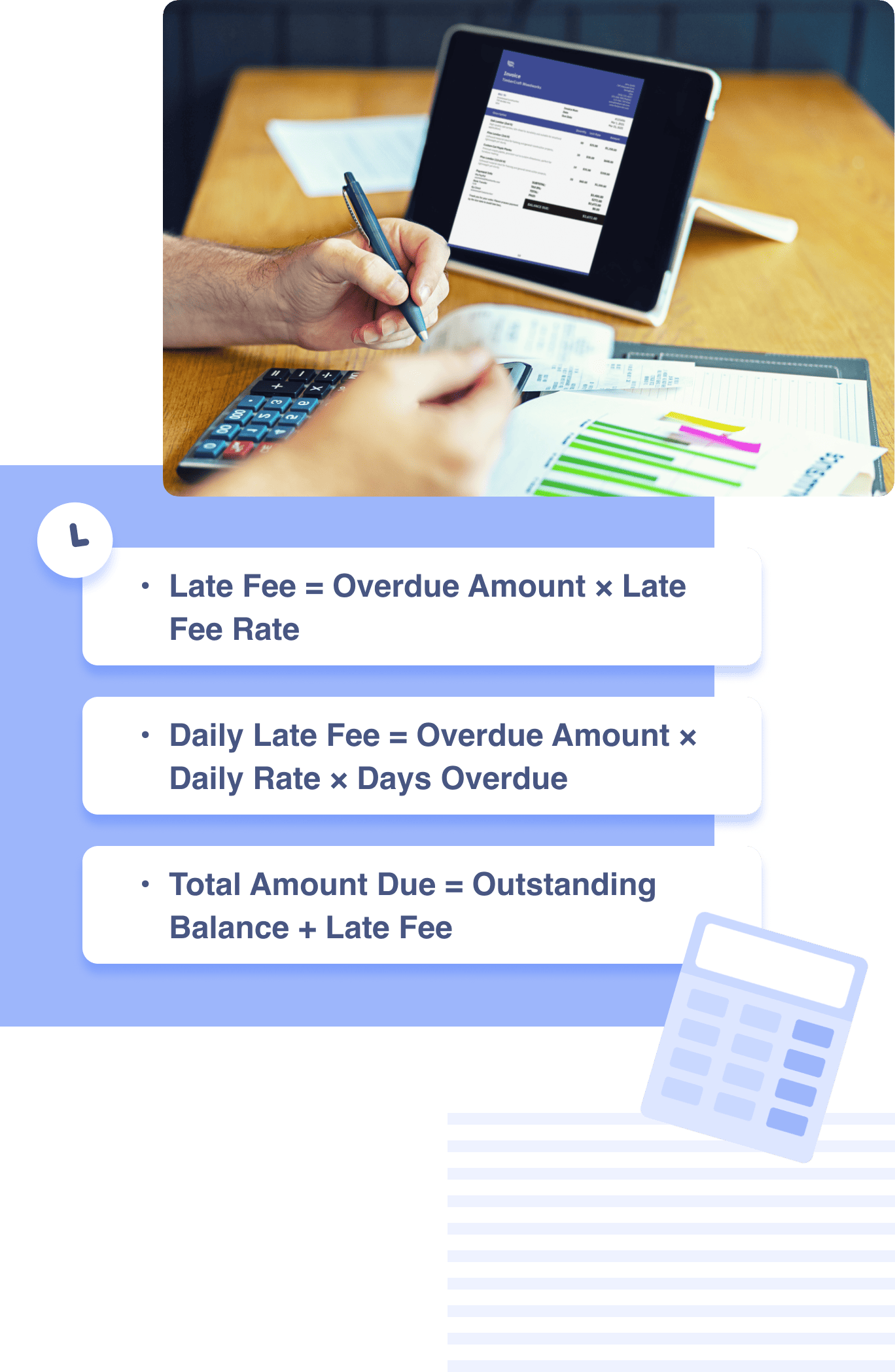
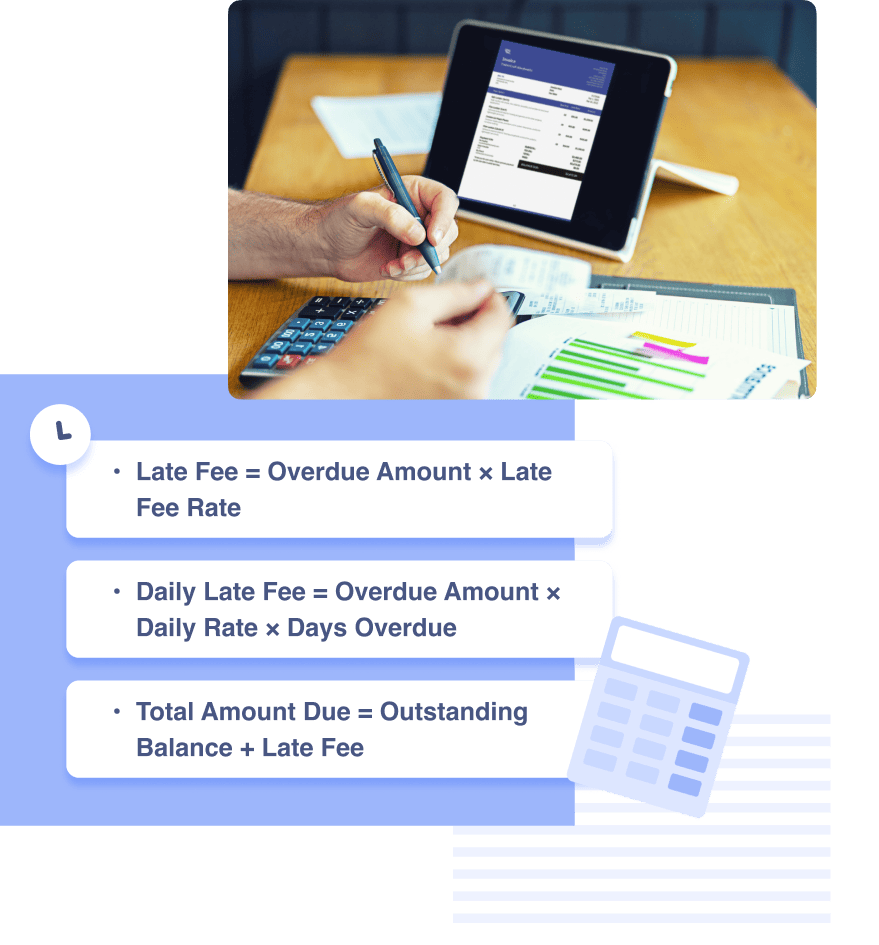
Late Fee = Overdue Amount × Late Fee Rate
For example, if a customer has an overdue invoice of $1,500 and the agreed late fee is 3%:
$1,500 × 3% = $45
The calculated late fee is $45, making the total amount due $1,545 before any other applicable charges.
When using a percentage, convert the rate into a decimal before calculating. For example:
- 1% = 0.01
- 2% = 0.02
- 3% = 0.03
- 5% = 0.05
Flat Late Fee
A flat late fee is a fixed amount charged when an invoice becomes overdue.
For example, if your payment terms specify a $25 late fee and a $900 invoice becomes overdue:
Late Fee = $25
The updated amount due would be:
$900 + $25 = $925
A flat fee does not change based on the invoice amount or number of overdue days unless your terms specify otherwise.
Daily Late Fee
A daily late fee applies a rate for each day an invoice remains unpaid.
A simple calculation is:
Daily Late Fee = Overdue Amount × Daily Rate × Days Overdue
For example, assume:
- Overdue invoice: $1,000
- Daily rate: 0.1%
- Days overdue: 10
The calculation is:
$1,000 × 0.1% × 10 = $10
The calculated late fee would be $10.
Monthly Late Fee
A monthly late fee applies a percentage or fixed charge for each month the invoice remains overdue.
For example, with a 2% monthly fee on a $2,000 outstanding balance:
$2,000 × 2% = $40
After one month, the calculated fee would be $40, assuming the fee is calculated on the same outstanding balance.
If the invoice remains unpaid for multiple months, the total depends on whether the terms use a simple recurring fee, compound calculation, or another method.
Which Late Fee Type Should You Use?
There is no single late fee structure that is appropriate for every business.
A business might prefer a flat fee because it is simple, while another may use a percentage-based or recurring charge because the fee is tied to the amount or duration of the overdue balance.
Whatever method you use, make sure your payment terms clearly explain:
- When a payment becomes overdue
- Whether a late fee applies
- How the fee is calculated
- When the fee is added
- Whether the fee repeats
- Any applicable limits or conditions
Check the rules that apply to your location and transaction before establishing or applying late payment charges.
How to Use the Late Fee Calculator
The calculator can simplify these calculations. Depending on the fee type, you may need to enter:
- 1Invoice amount
the unpaid amount subject to the fee
- 2Late fee rate
the percentage or applicable rate
- 3Days or months overdue
how long the payment has remained unpaid
- 4Fee type or frequency
such as flat, daily, or monthly
For a daily late fee, you can enter the number of overdue days manually or use the due date and calculate-through date to calculate business days automatically. The date calculation excludes Saturdays and Sundays but does not automatically exclude public holidays.
The calculator then provides an estimated late fee based on the information entered.
Late Fee Calculator Examples
The same overdue invoice can produce different results depending on the fee structure.
A customer has a $2,500 overdue invoice. The agreed late fee is 4%.
$2,500 × 4% = $100
Late fee: $100
Total amount due:
$2,500 + $100 = $2,600
This method is straightforward when the payment terms specify a percentage of the overdue balance.
A business charges a fixed $30 late fee when an invoice becomes overdue.
The invoice balance is $850.
$850 + $30 = $880
Late fee: $30
Total amount due: $880
The fee remains $30 regardless of whether the original invoice was $850 or another amount, assuming the same flat-fee terms apply.
Suppose an invoice has an outstanding balance of $1,500, with a daily late fee of 0.05%, and the payment is 20 days overdue.
First calculate the fee for one day:
$1,500 × 0.05% = $0.75
Then multiply by the number of overdue days:
$0.75 × 20 = $15
Late fee: $15
Total amount due: $1,515
This example assumes the daily fee is calculated against the same outstanding balance each day.
A $3,000 invoice is subject to a 1.5% monthly late fee.
For one month:
$3,000 × 1.5% = $45
Late fee: $45
Total amount due after one month:
$3,045
If the invoice remains unpaid, the calculation for subsequent months depends on the terms of the agreement.
Consider a $2,000 overdue invoice.
| Fee Type | Example Terms | Calculated Fee |
|---|---|---|
| Flat | $50 fixed fee | $50 |
| Percentage | 3% | $60 |
| Daily | 0.05% for 20 days | $20 |
| Monthly | 2% for 1 month | $40 |


These examples show why the fee structure matters. The same invoice balance can result in different charges depending on the rate and calculation method.
The examples are for mathematical illustration only. The amount you can legally charge may depend on your contract, payment terms, industry, and applicable requirements.
Frequently Asked Questions
Q: How do I calculate a late fee for an overdue invoice?
A: For a simple percentage-based fee, multiply the overdue amount by the late fee rate. For example, a 3% fee on a $1,000 balance is $30. Other fee structures may require the number of overdue days or months.
Q: Does a late fee apply automatically after the due date?
A: Not necessarily. Whether a late fee can be charged depends on the applicable payment terms, agreement, and requirements. An invoice becoming overdue does not by itself mean that every business can automatically add any fee it chooses.
Q: Can a late fee be charged on a partially paid invoice?
A: It depends on the agreed terms. Some fee structures may apply to the remaining unpaid balance, while others may use a different calculation method.
Q: How do I calculate late fees when the customer makes multiple payments?
A: You may need to recalculate the fee based on the remaining outstanding balance and the dates of the payments. The exact method depends on the terms governing the late fee.
Q: Can I charge a late fee on an invoice that is only one day overdue?
A: It depends on your payment terms. Some agreements specify a grace period before a late fee applies, while others may define the fee as becoming applicable immediately after the due date.
Q: What is the difference between a late fee and late payment interest?
A: A late fee is generally a charge associated with an overdue payment, while late payment interest is calculated using an interest rate applied to an unpaid balance. The terminology and rules can vary depending on the agreement and jurisdiction.
Q: Should a late fee appear as a separate line item?
A: Showing a late fee separately can make the updated balance easier for the customer to understand. You can identify the original invoice balance, the added fee, and the new amount due.
Q: Can I remove a late fee after calculating it?
A: If you decide to waive or adjust a late fee, keep your records updated so the customer and your accounting records reflect the correct amount due.
Q: Can this calculator calculate interest on overdue invoices?
A: A late fee calculator can estimate charges based on the inputs and calculation method it supports. If you are calculating statutory or contractual interest, verify the applicable rate and calculation requirements separately.