

What Does Due Upon Receipt Mean on an Invoice?
5min read
|
Sep 04, 2026
Due upon receipt means payment is expected when the customer receives the invoice. There is no standard 30-day or 60-day payment period attached to the invoice.
For example, if you send an invoice on September 1 with payment terms of "Due upon receipt", the customer is generally expected to pay as soon as they receive it.
That does not necessarily mean the customer must pay at the exact second the invoice arrives. In practice, the phrase means there is no additional payment window specified.
What Does Due Upon Receipt Mean?
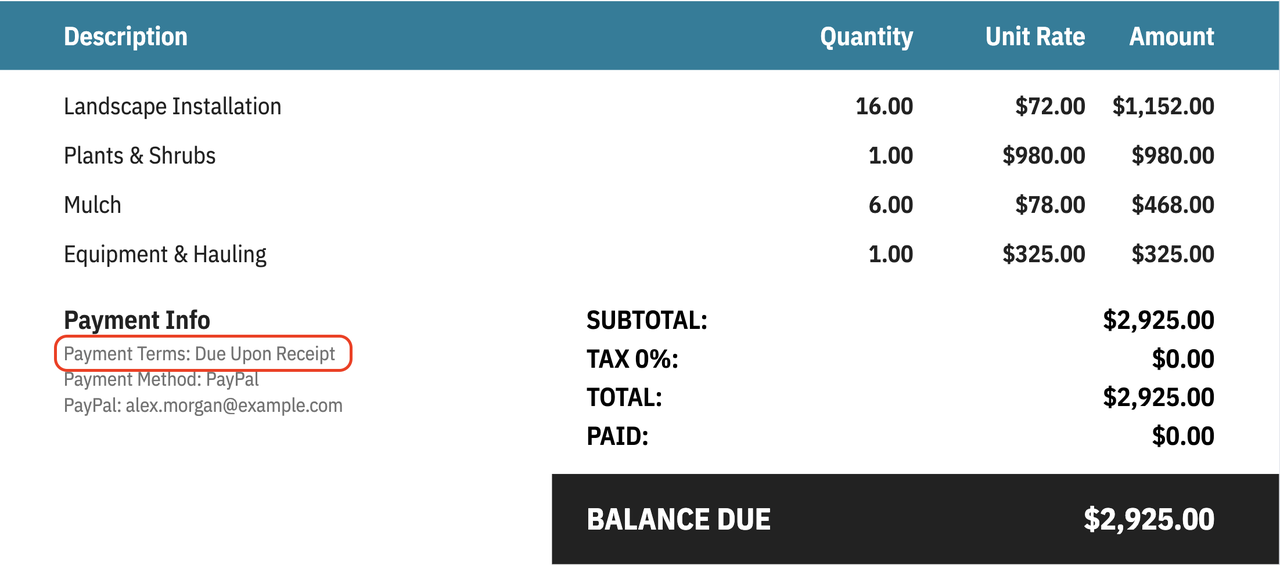
When an invoice says "Due upon receipt", the seller is asking the customer to pay promptly after receiving the invoice.
It is different from common payment terms such as:
- Net 7 — payment due within 7 days
- Net 15 — payment due within 15 days
- Net 30 — payment due within 30 days
- Net 60 — payment due within 60 days
With Net 30, the customer knows they have a defined 30-day period. With "Due upon receipt", there is no such waiting period.
For a small business, this can be useful when the business does not want to finance a customer's purchase or wait several weeks for payment.
It is particularly common for smaller jobs, one-time services, retail transactions, and customers who are expected to pay at the time of service.
Does Due Upon Receipt Mean Payment Is Due Immediately?
Generally, yes, but "immediately" can be misleading.
If a customer receives an invoice at 10 p.m., for example, it would be unreasonable to interpret the phrase as requiring payment within a few minutes.
The practical meaning is that the invoice is payable when received, rather than on a future date.
The exact timing can also depend on the agreement between the business and its customer. If the contract says something different, the contract may control.
This is one reason it is better to use clear payment terms rather than relying only on a phrase that could be interpreted differently by different customers.
For example, instead of writing only:
Due upon receipt
a business could write:
Payment is due upon receipt. Please pay within 24 hours of receiving this invoice.
That gives the customer a much clearer expectation.
When Should a Business Use Due Upon Receipt?
"Due upon receipt" makes the most sense when there is little reason to give the customer an extended payment period.
A few common situations include:
Small, One-Time Jobs
A business may not want to wait 30 days for a $150 or $300 job.
A handyman, cleaner, photographer, or repair technician may request payment when the work is finished.
Services Paid at the Time of Service
If the customer is already expected to pay when the service is completed, the invoice can reinforce that expectation.
For example, a customer receives a $200 repair invoice after the technician finishes the job. The invoice can state that payment is due upon receipt.
Upfront or Deposit Payments
A business requesting a deposit may also use immediate payment terms.
For example:
Project Deposit: $1,000
Payment Terms: Due upon receipt
The customer knows that the deposit needs to be paid before the business moves forward.
Customers Without Established Credit Terms
A business may be more comfortable requesting payment upon receipt from a new customer rather than automatically offering Net 30 terms.
For larger customers or long-term business relationships, however, longer payment terms may already be part of the agreement.
Due Upon Receipt vs. Other Payment Terms
The main difference between payment terms is how much time the customer has to pay.
| Payment Term | General Meaning |
|---|---|
| Due upon receipt | Payment is expected when the invoice is received |
| Net 7 | Payment is due within 7 days |
| Net 15 | Payment is due within 15 days |
| Net 30 | Payment is due within 30 days |
| Net 60 | Payment is due within 60 days |
| Due on a specific date | Payment is due on the stated date |
The choice can affect cash flow, especially if your business has regular expenses such as payroll, materials, rent, or inventory.
Suppose you complete a $2,000 project on September 1.
With "Due upon receipt", you are asking for payment as soon as the customer receives the invoice.
With Net 30, the customer may have until around October 1 to pay.
That one difference can matter to a small business that has payroll, materials, rent, or other bills to cover.
At the same time, giving customers longer payment terms can sometimes make it easier to win and retain business. Some larger companies routinely require Net 30, Net 60, or even longer terms from their suppliers.
So payment terms are not just an invoicing detail. They are part of the business relationship.
How to Put Due Upon Receipt on an Invoice
The simplest approach is to put the payment term somewhere easy to find.
For example:
Payment Terms: Due upon receipt
You can also make the instruction more specific:
Payment is due upon receipt of this invoice.
Or:
Payment is due when this invoice is received.
If you accept online payments, include the payment option directly on the invoice whenever possible. A customer who can open the invoice, see the amount due, and pay without searching for payment instructions is more likely to complete the payment promptly.
Also make sure the invoice includes the information the customer needs to pay, such as:
- Amount due
- Accepted payment methods
- Payment link or bank details
- Invoice number
- Contact information
If you charge a late fee, don't assume that "due upon receipt" automatically gives you the right to charge one. Late fees may depend on the agreement with the customer and applicable laws.
For that reason, it is better to establish any late-payment terms before sending the invoice.
"Due upon receipt" is a simple payment term, but it sets a very different expectation from Net 30 or Net 60. If your business expects customers to pay as soon as they receive an invoice, say so clearly and make the payment process easy.
For small businesses, the biggest benefit is straightforward: the sooner an invoice is paid, the sooner the business has the cash to use for its own expenses and operations.
Most Popular Pages


Try Invoice Zip Today
Start Sending Invoices, Building Reports, Saving Office
Time and Get Paid Faster.