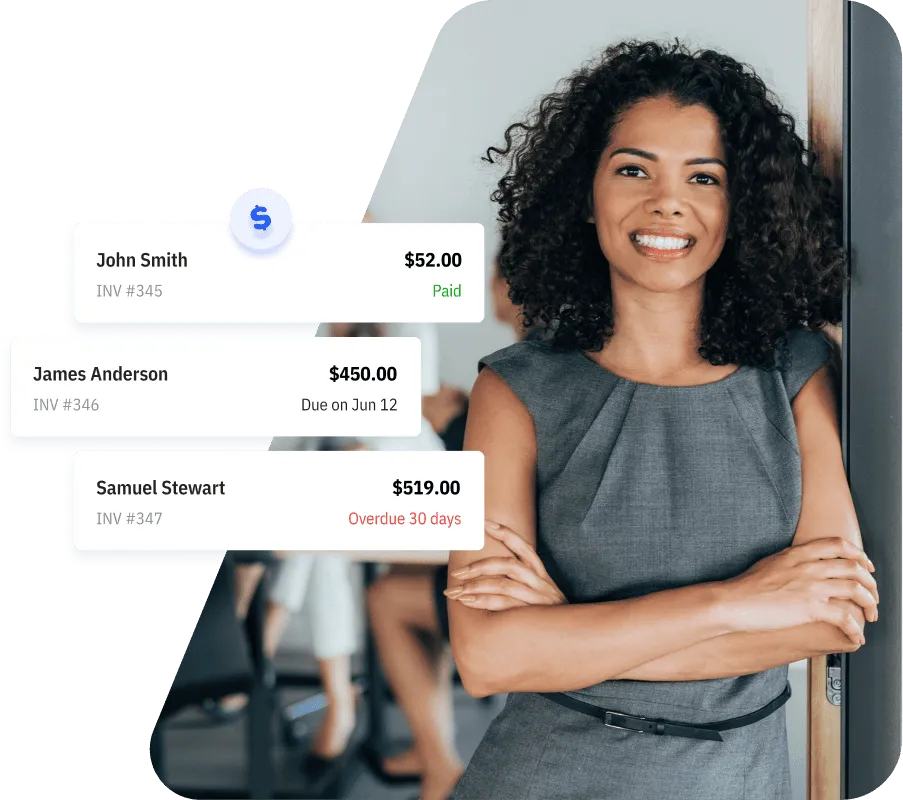


How to Track Payments and Mark Invoices as Paid
12min read
|
Sep 11, 2026
Keeping track of invoices and payments helps you know what customers owe, which invoices have been paid, and which payments still need to be recorded or reconciled. It also makes it easier to follow up on overdue invoices and maintain accurate financial records.
A good tracking system should connect each payment to the correct invoice, show the remaining balance, and keep a clear history of what was paid and when. You can do this manually with a spreadsheet or use invoicing software to manage invoices, payments, and outstanding balances.
Quick Answer
To track invoices and payments, create a record for every invoice you send and update that record whenever you receive a payment.
For each invoice, keep track of:
- Invoice number
- Customer name
- Invoice date
- Due date
- Invoice amount
- Amount paid
- Remaining balance
- Payment status
- Payment date
- Payment method
- Transaction or payment reference, when available
Use clear payment statuses such as Unpaid, Partially Paid, Paid, Overdue, and Overpaid.
When a customer makes a partial payment, record the payment and reduce the outstanding balance, but do not mark the invoice as fully paid. When the full amount has been received and the payment is confirmed, mark the invoice as Paid.
If a customer pays more than the invoice amount, record the overpayment separately and determine whether it should be refunded, applied to another invoice, or kept as a customer credit. If a payment fails, is reversed, or is refunded, update the payment and invoice records accordingly.
You can track invoices and payments manually with a spreadsheet or use invoicing software to record payments, update invoice statuses, monitor outstanding balances, and send payment reminders. Regardless of the method, regularly compare your records with your bank account or payment processor and keep paid invoices and payment histories for future reference.
Invoice and Payment Tracking Checklist
- Record every invoice you send.
- Give each invoice a unique invoice number.
- Record every customer's payment.
- Match each payment to the correct invoice.
- Update the amount paid and remaining balance.
- Track unpaid, partially paid, overdue, and paid invoices.
- Record overpayments separately.
- Mark an invoice as paid only after the full amount has been received and confirmed.
- Correct payment or invoice status errors when they occur.
- Reconcile your records with your bank or payment processor.
- Keep paid invoices and supporting payment records.
How to Track Invoices
Invoice tracking starts when you create an invoice and continues until the invoice has been fully paid.
A basic invoice tracking system should show the current status of every invoice and the amount still outstanding.
Useful information to track includes:
| Invoice Number | Customer | Invoice Date | Due Date | Invoice Amount | Amount Paid | Balance | Status |
|---|---|---|---|---|---|---|---|
| INV-1025 | ABC Company | June 1 | July 1 | $2,000 | $1,000 | $1,000 | Partially Paid |
| INV-1026 | XYZ Company | June 5 | July 5 | $1,500 | $0 | $1,500 | Unpaid |
| INV-1027 | DEF Company | May 10 | June 10 | $800 | $800 | $0 | Paid |
This gives you an overview of which invoices still need attention.
Track Invoice Status
A consistent status system makes invoice tracking easier.
Common statuses include:
- Unpaid: No payment has been received.
- Partially Paid: The customer has paid some, but not all, of the invoice.
- Paid: The full amount due has been received.
- Overdue: The due date has passed and there is still an outstanding balance.
- Overpaid: The customer has paid more than the invoice amount.
You can also use additional statuses for your workflow, such as draft, sent, or canceled. The important thing is to use the same definitions consistently.
Track Due Dates and Outstanding Balances
The invoice due date tells you when payment is expected.
For each unpaid invoice, track how much remains outstanding:
Remaining Balance = Invoice Amount − Total Payments Received
For example, if a customer owes $2,500 and has paid $1,000:
$2,500 − $1,000 = $1,500
The invoice has a remaining balance of $1,500.
Tracking the balance separately from the original invoice amount helps you avoid confusion when customers make multiple payments.
How to Record and Track Payments
When a customer pays an invoice, record the payment against the correct invoice rather than simply recording that money was received.
For each payment, keep information such as:
- Invoice number
- Customer name
- Payment date
- Payment amount
- Payment method
- Transaction or payment reference
- Payment processor, if applicable
- Remaining invoice balance
- Notes about the payment
For example, suppose you issue a $2,000 invoice and receive a $1,000 payment on June 10.
The payment record could show:
| Invoice | Invoice Amount | Payment Date | Payment Amount | Remaining Balance |
|---|---|---|---|---|
| INV-1025 | $2,000 | June 10 | $1,000 | $1,000 |
If the customer pays the remaining $1,000 on June 25, record the second payment separately.
| Invoice | Invoice Amount | Payment Date | Payment Amount | Remaining Balance |
|---|---|---|---|---|
| INV-1025 | $2,000 | June 10 | $1,000 | $1,000 |
| INV-1025 | $2,000 | June 25 | $1,000 | $0 |
This gives you a complete payment history instead of only showing the final paid status.
Match Payments to the Correct Invoice
Matching payments to invoices is especially important when a customer has several outstanding invoices.
For example, a customer may owe:
- INV-1001: $1,000
- INV-1002: $1,500
- INV-1003: $800
If you receive a $1,000 payment from that customer, you should determine which invoice the payment is intended to cover before updating its status.
If the customer includes an invoice number or payment reference, use that information when matching the payment. If the payment cannot be identified immediately, keep it separate until you can determine where it belongs.
Incorrectly matching a payment can cause one invoice to appear paid while another invoice remains incorrectly outstanding.
How to Handle Partial Payments and Overpayments
Customer payments do not always match the exact amount of an invoice. Your tracking system should account for partial payments, overpayments, and payments that are later reversed or refunded.
Partial Payments
A partial payment occurs when a customer pays only part of the amount due.
For example:
Invoice Total: $3,000
Payment Received: $1,200
Remaining Balance: $1,800
Record the $1,200 payment, but keep the invoice as partially paid.
If the customer later pays another $800:
$3,000 − $1,200 − $800 = $1,000
The invoice still has an outstanding balance of $1,000.
If the customer makes several payments, record each payment separately rather than replacing the previous payment amount.
This creates a clear payment history and makes it easier to determine exactly how much has been paid.
Overpayments
An overpayment occurs when a customer pays more than the invoice amount.
For example, if an invoice is $800 and the customer pays $900, there is a $100 overpayment.
Record the full payment and identify the extra $100 separately.
Depending on the circumstances, the excess amount may be:
- Refunded to the customer
- Applied to another invoice
- Kept as a customer credit
Do not leave the extra amount unexplained or treat it as part of the original invoice amount.
The correct accounting treatment can depend on your business practices and the circumstances of the payment.
Failed, Reversed, or Refunded Payments
A payment that initially appears successful may later fail, be reversed, or be refunded.
For example, a payment processor may reverse a transaction, or you may refund a payment after a customer dispute.
When this happens, update both the payment record and the invoice balance as needed.
Otherwise, an invoice could remain marked as paid even though the money was no longer successfully received.
When to Mark an Invoice as Paid
An invoice should generally be marked as Paid when the full amount due has been received and the payment has been confirmed.
For example, if an invoice is $2,000 and the customer has paid $1,500, the invoice should not be marked as fully paid. The remaining $500 is still outstanding.
Once the final $500 is received and confirmed, the balance becomes zero and the invoice can be marked as paid.
What to Keep After an Invoice Is Paid
Changing the status to Paid should not remove the payment history.
Keep the original invoice together with information such as:
- Payment date
- Payment amount
- Payment method
- Transaction reference
- Partial payment history, if applicable
- Refunds or adjustments
- Relevant notes
This gives you a complete record of the transaction.
Paid invoices can also help you review customer payment history and answer questions about when and how an invoice was paid.
What If You Mark an Invoice as Paid by Mistake?
An invoice can sometimes be marked as paid accidentally.
For example, you may receive a $1,000 partial payment on a $2,000 invoice but accidentally change the invoice status to Paid.
If this happens, correct the invoice and payment records.
A basic correction process is:
- Check the actual payment amount.
- Confirm the payment date and transaction reference.
- Compare the payment with the original invoice amount.
- Calculate the correct remaining balance.
- Change the invoice to the correct status.
- Keep a record of the correction when appropriate.
In the example above, the invoice should be changed from Paid to Partially Paid, with $1,000 still outstanding.
Avoid simply deleting the payment history if it is important to maintain an accurate record of the transaction. A clear record of the correction can make future reconciliation easier.
Manual vs. Invoicing Software
You can track invoices and payments manually or use invoicing software. The better option depends largely on the number of invoices you manage and how frequently customers pay.
Tracking Invoices and Payments Manually
A spreadsheet can work well for a small business with a limited number of customers and invoices.
You could create columns for:
| Invoice Number | Customer | Invoice Amount | Due Date | Amount Paid | Balance | Status | Payment Date |
|---|
Each time you send an invoice, add a new row. When a customer pays, update the payment amount, balance, status, and payment date.
Manual tracking gives you flexibility and does not require specialized software.
However, it also means you are responsible for keeping every record accurate. As the number of invoices increases, it becomes easier to:
- Forget to record a payment
- Match a payment to the wrong invoice
- Calculate the wrong balance
- Leave a paid invoice marked as unpaid
- Miss a partial payment
- Overlook overdue invoices
Tracking Invoices and Payments with Invoicing Software
Invoicing software can simplify many parts of the tracking process.
Depending on the software, you may be able to:
- Create and send invoices
- Record payments directly against invoices
- Update invoice statuses
- Calculate outstanding balances
- Keep payment histories
- Accept online payments
- Send payment reminders
- Track overdue invoices
- Generate invoice and payment reports
This can reduce repetitive data entry and give you a clearer view of your outstanding invoices.
However, software does not eliminate the need to review your records. Payments can still fail, be reversed, be refunded, or be recorded incorrectly.
You should still reconcile your records regularly.
How to Manage Paid Invoices
A paid invoice should remain part of your business records after the customer has paid.
The invoice provides a record of what the customer was charged, while the payment record shows how and when the amount was paid.
Together, they can document:
- What products or services were provided
- The amount charged
- When the invoice was issued
- The payment date
- The payment amount
- The payment method
- Whether the invoice was paid in full
Keep Paid Invoices With Payment Records
Whenever possible, keep the original invoice and related payment records together.
For example, if a $3,000 invoice was paid in three installments, your records should show the original $3,000 invoice and all three payments.
This is more useful than simply changing the status to Paid because it preserves the complete history of the transaction.
Organized records can also make it easier to respond to customer questions, review previous transactions, and maintain your financial records.
Do You Need to Send a Paid Invoice to the Customer?
You do not always need to send a separate paid invoice after receiving payment.
Whether you should send one depends on your process and the customer's needs.
A paid invoice can be useful when:
- The customer wants confirmation of payment.
- The customer needs a copy for their records.
- The invoice was paid in multiple installments.
- The customer requests documentation.
- You want to provide a clear record showing that the balance is zero.
If your payment system already provides a receipt or payment confirmation, sending a separate paid invoice may not always be necessary.
If you do send one, make sure the invoice clearly shows that it has been paid and, where appropriate, includes the payment date and amount.
Best Practices for Tracking Invoices and Payments
A consistent tracking process can help prevent missing payments, incorrect balances, and outdated invoice statuses.
Record Payments Promptly
Record payments as soon as practical after they are received and confirmed.
Waiting several days can make it easier to forget a payment or apply it to the wrong invoice.
Use Unique Invoice Numbers
Give every invoice a unique invoice number.
Use that number when recording payments so each payment can be matched to the correct invoice.
This becomes particularly important when the same customer has several outstanding invoices.
Keep the Original Invoice Amount
Do not overwrite the original invoice amount when a customer makes a payment.
Instead, keep the original amount, payments received, and remaining balance separately.
This makes the payment history easier to understand and verify.
Review Outstanding Invoices Regularly
Review your unpaid and overdue invoices on a regular schedule.
A simple invoice or payment report can help you identify:
- Unpaid invoices
- Partially paid invoices
- Overdue balances
- Customers with multiple outstanding invoices
- Payments that have not yet been matched to invoices
Regular reviews make it easier to follow up with customers before outstanding balances become significantly overdue.
Reconcile Payments With Your Bank or Payment Processor
Your invoice records should be compared with the transactions actually appearing in your bank account or payment processor.
Check items such as:
- Payment amounts
- Payment dates
- Customer or payer information
- Transaction references
- Processing fees
- Refunds
- Reversed transactions
For example, a customer may pay $1,000 through a payment processor, but only $970 may reach your bank account after a $30 processing fee.
Your records should distinguish between the customer's $1,000 payment and the $30 processing fee rather than treating the deposit as a $970 customer payment.
Regular reconciliation can help identify missing payments, duplicate entries, incorrect invoice statuses, and other discrepancies.
Keep Supporting Records
Keep invoices, payment confirmations, receipts, transaction references, and relevant customer correspondence with your financial records.
These records can be useful when resolving payment disputes, answering customer questions, or reviewing past transactions.
Final Thoughts
Tracking invoices and payments means keeping a clear record of the entire payment process, from the moment an invoice is issued to the moment its balance reaches zero.
A reliable system should show the original invoice amount, payments received, remaining balance, due date, and current status. It should also account for partial payments, overpayments, failed or reversed payments, and corrections.
For a small business, a spreadsheet may be enough. As the number of invoices and payments grows, invoicing software can make it easier to manage balances, payment histories, overdue invoices, and customer records.
The goal is simple: at any time, you should be able to see which invoices are unpaid, how much each customer still owes, what payments have been received, and which invoices have been fully paid.
Most Popular Pages
Try Invoice Zip Today
Start Sending Invoices, Building Reports, Saving Office
Time and Get Paid Faster.