


What Is a Credit memo
5min read
|
Sep 04, 2026
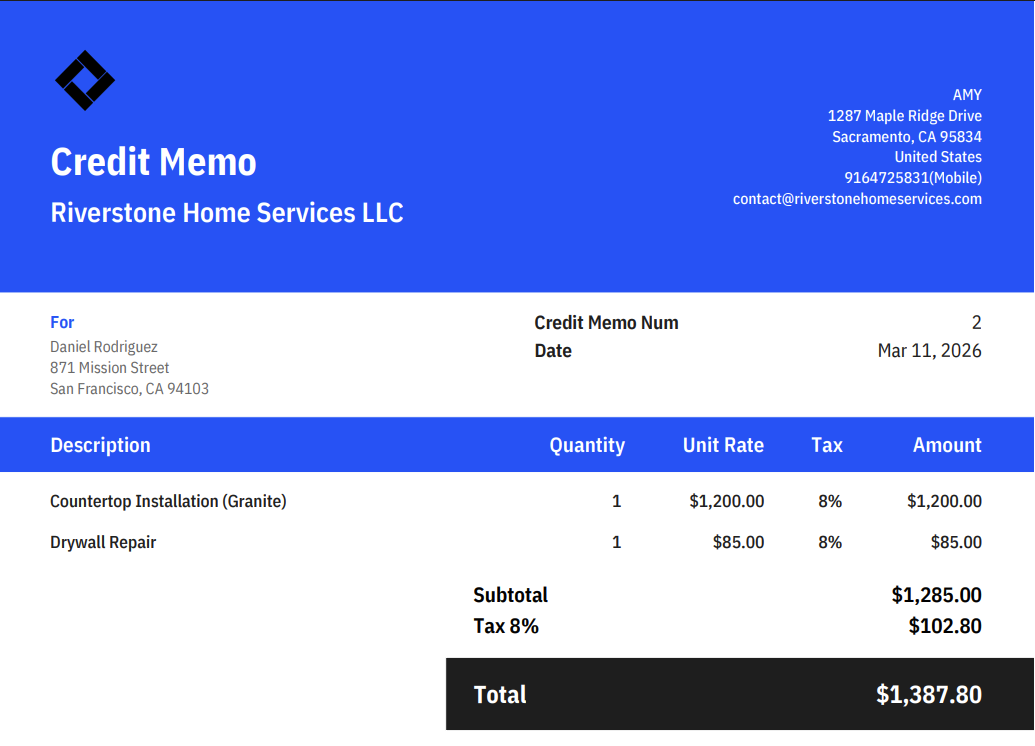
A credit memo is a document issued by a business to reduce the amount a customer owes. It is commonly used when a customer returns a product, receives a discount after invoicing, or was charged more than the agreed amount.
A credit memo does not request payment. Instead, it adjusts an existing invoice or creates a credit that can be applied to a future invoice.
What Does a Credit Memo Mean?
A credit memo, also called a credit note, shows that a business has reduced all or part of a customer’s balance.
For example, imagine that you send a customer an invoice for $1,000. After reviewing the work, you agree to provide a $150 discount. Instead of deleting the original invoice, you can issue a $150 credit memo.
The customer’s updated balance is now $850.
A credit memo creates a clear record of why the original amount changed.
When Should You Issue a Credit Memo?
A business may issue a credit memo for several reasons.
Common situations include:
- A customer returns goods
- A product arrives damaged
- A service is cancelled
- The customer was charged too much
- A discount is approved after invoicing
A credit memo can also be used to correct an invoice that contains an incorrect charge. The original invoice should usually remain in the records, while the credit memo documents the adjustment.
Credit Memo vs. Refund
A credit memo and a refund are related, but they are not the same thing.
A credit memo reduces what the customer owes. A refund sends money back to the customer.
For example, if a customer has an unpaid invoice, you may issue a credit memo and reduce the amount due. If the customer has already paid the invoice, you may need to issue a refund instead.
| Situation | Common action |
|---|---|
| Invoice is unpaid | Apply a credit memo to reduce the balance |
| Customer paid too much | Issue a refund or keep a customer credit |
| Product is returned before payment | Issue a credit memo |
| Product is returned after payment | Issue a credit memo and refund if appropriate |
| Customer receives a later discount | Apply a credit memo to the original invoice |
The correct process depends on your agreement with the customer and your accounting procedures.
What Information Should a Credit Memo Include?
A credit memo should contain enough information to explain the adjustment.
Include:
- Business name and contact information
- Customer name and billing details
- Credit memo number
- Date of issue
- Original invoice number
- Reason for the credit
- Products or services being adjusted
- Credit amount
- Tax adjustment, if applicable
- Remaining balance or application instructions
The credit memo number should be unique, just like an invoice number. You can use a separate format such as CM-2026-001.
Referencing the original invoice is especially important. It allows both you and the customer to connect the credit with the correct transaction.
How to Calculate a Credit Memo
The credit amount should match the value being adjusted.
For example, a customer receives three damaged products at $100 each. The credit memo amount may be $300 before tax.
If tax was included on the original invoice, the related tax adjustment may also need to be shown.
Example:
Original invoice: $1,200
Returned products: $300
Tax adjustment: $30
Updated balance: $870
The exact calculation depends on the original invoice and the tax rules that apply to the transaction.
Should a Credit Memo Be Applied to the Original Invoice?
In many cases, the credit memo is applied to the original invoice.
For example:
Original invoice amount: $2,500
Credit memo: $400
New balance due: $2,100
This is usually the clearest approach when the invoice has not yet been paid.
However, a business may also keep the credit on the customer’s account and apply it to a future invoice. If you do this, tell the customer how much credit is available and when it will be used.
What If the Customer Has Already Paid?
If the customer has already paid the invoice, the business may need to issue a refund.
Another option is to keep the amount as a credit for a future purchase. This should be agreed upon with the customer.
Do not assume that a customer wants a future credit instead of a refund. Confirm the customer’s preference and keep a record of the decision.
Credit Memos for Partial Adjustments
A credit memo does not have to cancel an entire invoice.
It can adjust one part of a transaction.
For example, a contractor may issue an invoice for:
- Labor: $1,500
- Materials: $800
- Delivery: $100
If the customer disputes a $100 delivery fee and the business agrees, the credit memo can reduce only that charge.
The updated invoice balance would then be $2,300 instead of $2,400.
Partial adjustments are useful because they preserve the accurate parts of the original invoice.
Common Credit Memo Mistakes
Avoid these common problems:
- Deleting the original invoice instead of creating a credit memo
- Failing to reference the original invoice
- Issuing a credit without explaining the reason
- Applying the credit to the wrong customer
- Forgetting to adjust related taxes
- Failing to tell the customer how the credit will be used
A credit memo should create a clear audit trail. Anyone reviewing the records later should be able to understand what changed and why.
How Invoice Software Can Help
Invoice software can help you create credit memos, connect them to original invoices, update customer balances, record refunds, and maintain a complete payment history.
Invoice Zip helps businesses manage invoices, credits, payments, and customer records in one place.
Final Thoughts
A credit memo is used to reduce a customer’s balance after an invoice has been issued.
It can be helpful when products are returned, services are cancelled, discounts are approved, or billing errors need to be corrected.
A clear credit memo should explain:
- Which invoice is being adjusted
- Why the adjustment is being made
- How much credit is being issued
- Whether the credit reduces the current balance or applies to a future invoice
Keeping the original invoice and recording the adjustment separately makes your billing process easier to understand and manage.
Most Popular Pages


Try Invoice Zip Today
Start Sending Invoices, Building Reports, Saving Office
Time and Get Paid Faster.