

Plumbing Invoice Template
Designed for independent plumbing contractors, small plumbing businesses, and field service teams.
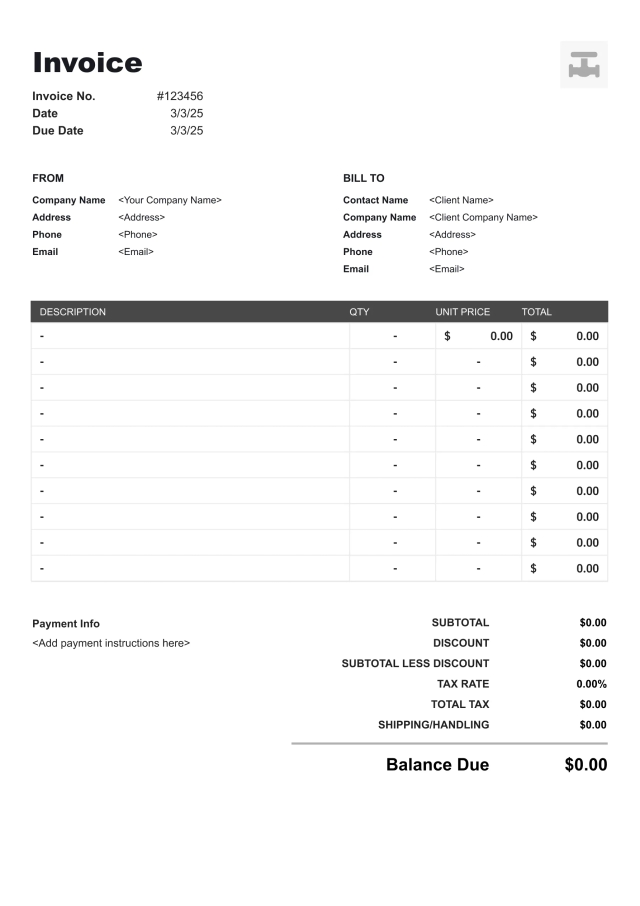
Choose the Right Plumbing Invoice Template
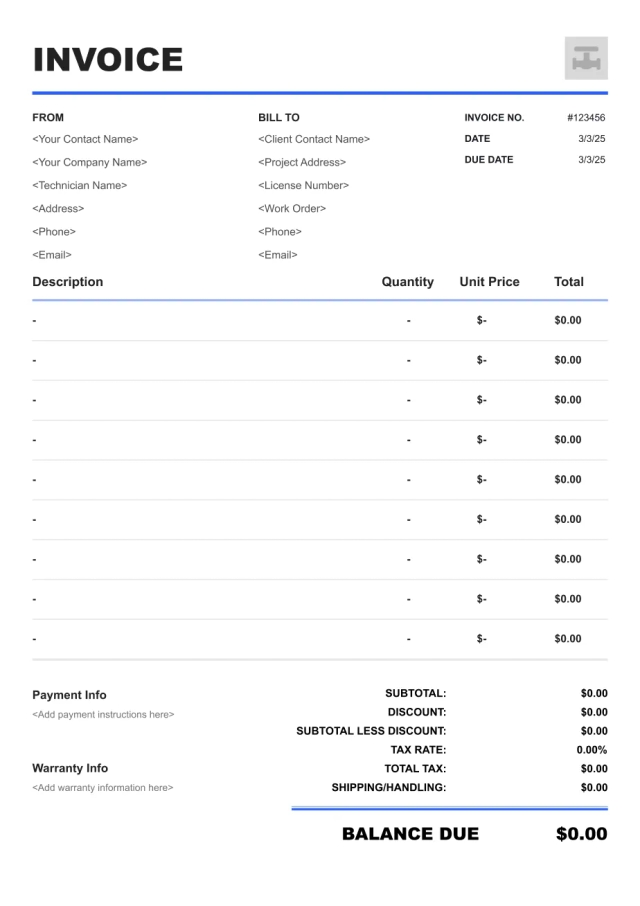


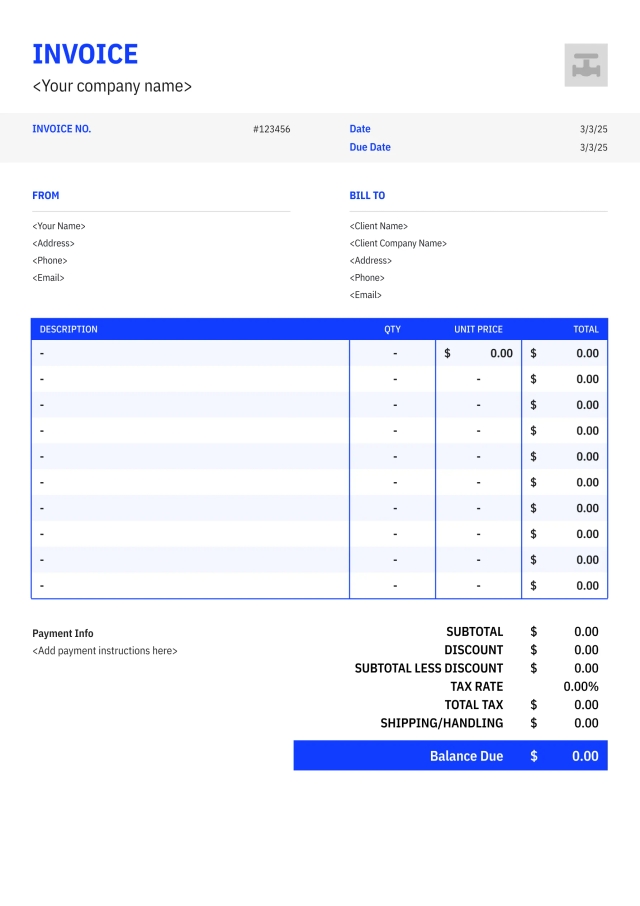
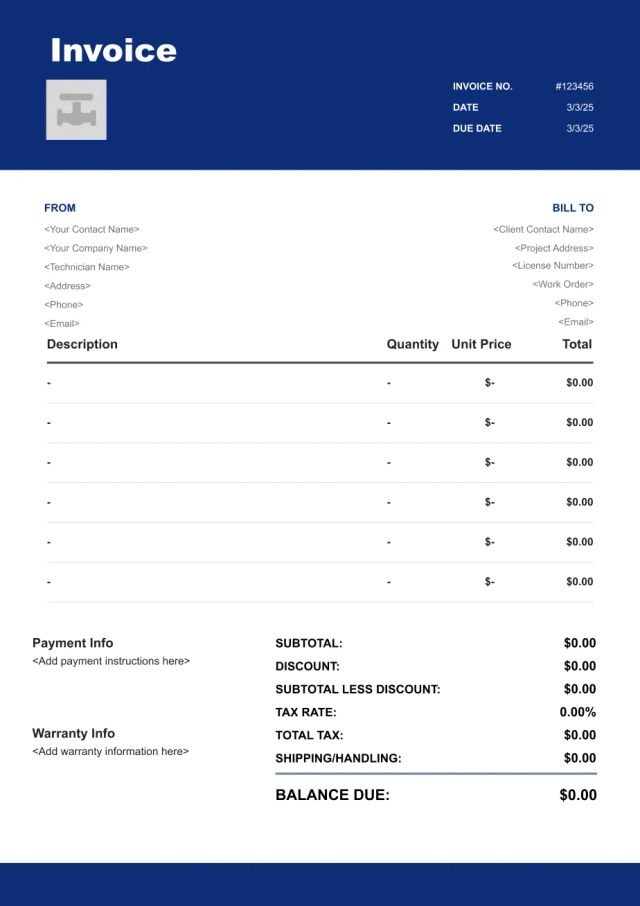
What to Include on a Plumbing Invoice
(+ Annotated Invoice Example)
To prevent chargebacks and liability disputes, your invoice must accurately capture precise fleet management and driver verification data.
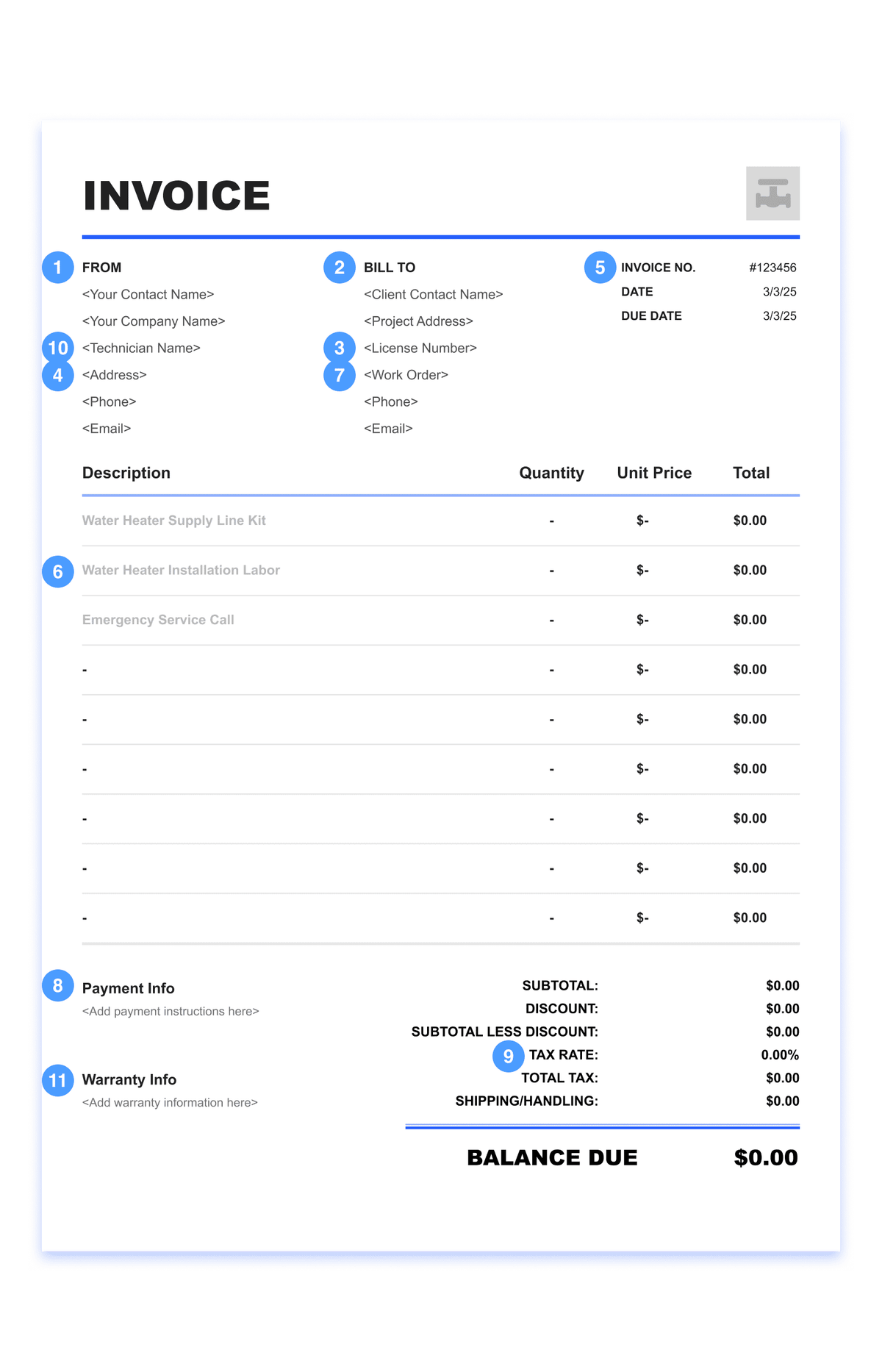
Business name, address, phone, email
Client name, address, phone, email
License number: Plumber license number
Job location: Project address
Invoice number, invoice date and due date
Billing Items: Break down labor charges, plumbing materials, replacement parts, service fees, taxes, and any emergency or after-hours charges.
Work order or estimate number (if applicable)
Payment terms
Subtotal, taxes, and total amount due
Technician name: Name of the technician or crew leader who performed the work (mainly for team-based businesses).
Warranty information: Brief summary of workmanship or parts warranty coverage, if applicable.
Common Plumbing Services & Billing Items
See how different plumbing services are typically billed and itemized on invoices.
Drain Cleaning
Clearing clogged drains or sewer lines
Leak Detection & Repair
Finding and fixing water leaks
Water Heater Installation & Repair
Installing or replacing water heaters
Pipe Repair & Repiping
Repairing or replacing pipe systems
Fixture Installation
Installing toilets, faucets, sinks
Sewer Line Services
Sewer inspection and repair work
Emergency Plumbing Services
Urgent or after-hours repairs
Commercial Plumbing Work
Large-scale commercial plumbing jobs
Preventive Maintenance
Routine plumbing maintenance


Reusable Billing Structure in Invoice Software
Use the items above to quickly build plumbing invoices in Invoice Zip
Common Plumber Invoicing Mistakes
Avoid frequent invoicing errors that can lead to delayed payments, confusion, or missed charges.
| Mistake | What Goes Wrong | How to Fix |
|---|---|---|
Not itemizing labor and materials | Labor and materials are combined, making the invoice unclear and harder to verify | Break down labor and materials into separate line items |
Missing service call or dispatch fees | Travel or on-site visit costs are not included, leading to underbilling | Add a fixed service call or dispatch fee for each visit |
Using vague job descriptions | Descriptions like "plumbing work" do not explain what was actually done | Use specific task descriptions (e.g., leak repair, faucet replacement) |
Forgetting emergency or after-hours charges | Urgent or off-hours work is billed at standard rates instead of premium pricing | Apply emergency or after-hours surcharge when applicable |
Missing permit or inspection numbers | Compliance references are not recorded, which can slow approvals or create documentation issues | Include permit or inspection numbers in the invoice details |
No clear payment terms | Lack of due date or payment conditions leads to delayed payments | Specify payment terms such as due date or "Net 7/14" |
Missing or inconsistent invoice numbers | Makes it difficult to track jobs and payments over time | Use a consistent invoice numbering system |
Not including additional fees | Travel, diagnostic, or permit-related costs are left out of the final invoice | Add all applicable fees as separate line items |
Plumbing Invoice Challenges and Solutions
Discover common invoicing challenges plumbers face in the field and practical ways to improve billing accuracy and workflow efficiency.
| Challenge | Solution |
|---|---|
Estimate and actual work may differ during plumbing jobs, as unexpected issues can arise on-site, making it difficult to ensure the final invoice fully reflects completed work. | Update job notes in real time during the work process so the final invoice accurately reflects actual tasks, materials, and time spent. |
Tracking labor and materials during active work is difficult, especially when multiple tasks are involved, which can lead to incomplete or inaccurate invoices. | Record labor time and materials immediately during or after each task to ensure accurate billing at the end of the job. |
CRM and invoicing tools can feel too complex for small plumbing businesses or solo contractors, slowing down rather than improving workflow efficiency. | Use simplified invoicing tools or templates designed for small teams, prioritizing speed and ease of use over full-featured systems. |
FAQ about Plumbing Invoicing
Q: How should recurring or unresolved drain clogs be billed?
Typically billed as a new service call unless the contractor explicitly offers a warranty period.
- If within warranty → no charge or discounted revisit
- If outside warranty → full service call + labor again
- Often treated as a new job, not continuation
Q: How should permit fees and inspection re-visits be invoiced?
Usually handled as pass-through costs + separate line items.
- Permit fees → billed at cost (sometimes with small admin fee)
- Failed inspection re-visits → billed as new service call or labor time
- Always itemized separately for compliance clarity
Q: How should diagnostic work like leak detection or camera inspections be billed separately?
Common practice is to charge diagnostics as a separate service fee.
- Leak detection → diagnostic fee or hourly labor
- Camera inspection → fixed inspection fee
- If repair follows, diagnostic fee may be partially waived (depends on company)
Q: How should labor be handled when a job includes multiple services?
Industry standard is to split labor by service line when possible.
- Each service gets its own labor allocation
- If not practical → combined labor with detailed description
- Goal is traceability per task, not just total hours
Q: How should trip fees and first-hour minimums be structured?
Most common structure:
- Trip / service call fee → covers dispatch & travel
- First-hour minimum → ensures short jobs are still profitable
- After first hour → hourly rate or per-job rate
They are usually separate line items, not merged.
Q: How should material markups be applied on plumbing parts?
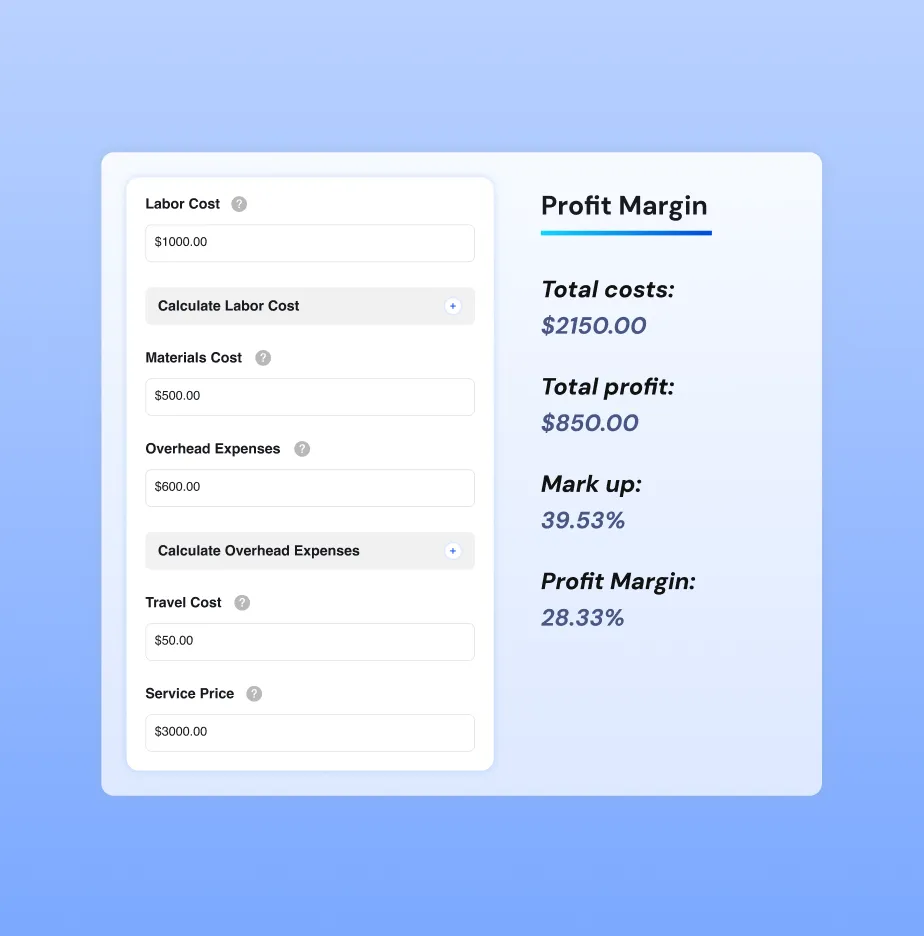
Standard practice is percentage markup over cost price.
- Common range: ~10%–50% depending on market and urgency
- High-frequency items (fittings, valves) often lower markup
- Specialized or emergency parts → higher markup allowed
- Always shown as itemized material line, not hidden
Q: How should plumbers charge for emergency or after-hours calls?
Typical structure:
- Base service call fee + emergency surcharge
- Plus labor (often higher hourly rate)
- Materials billed normally
- Emergency premium usually 1.5x–2x labor rate or fixed fee add-on
Other Free Resources
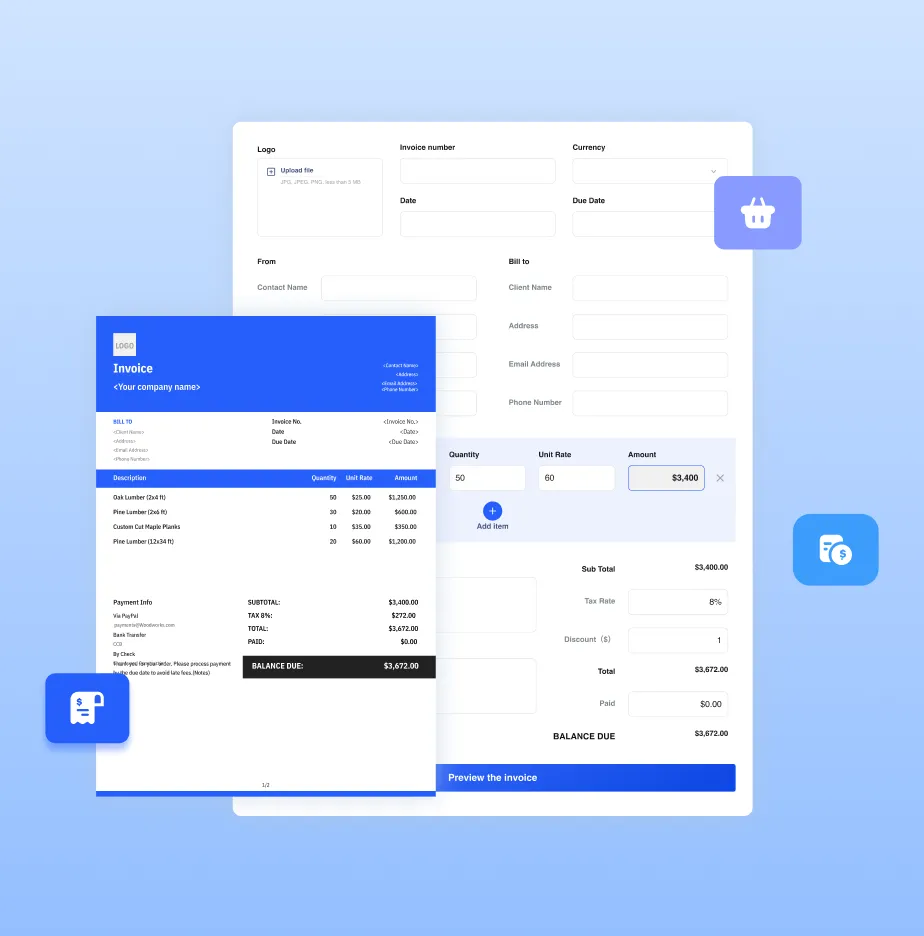

Try Invoice Zip Today
Start Sending Invoices, Building Reports, Saving Office
Time and Get Paid Faster.