


Car Rental Invoice Template
Designed for car rental companies, rental agencies, and vehicle leasing businesses.
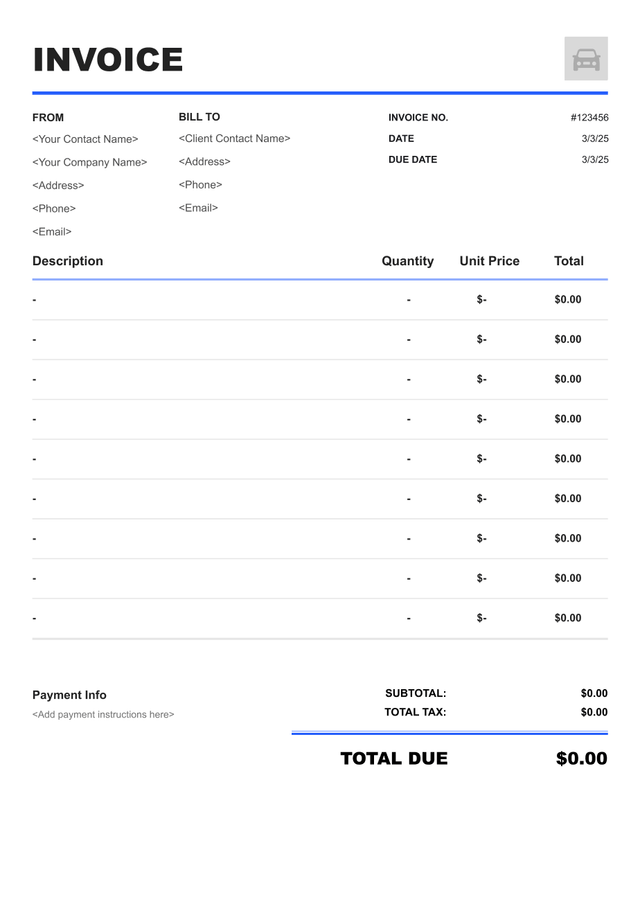
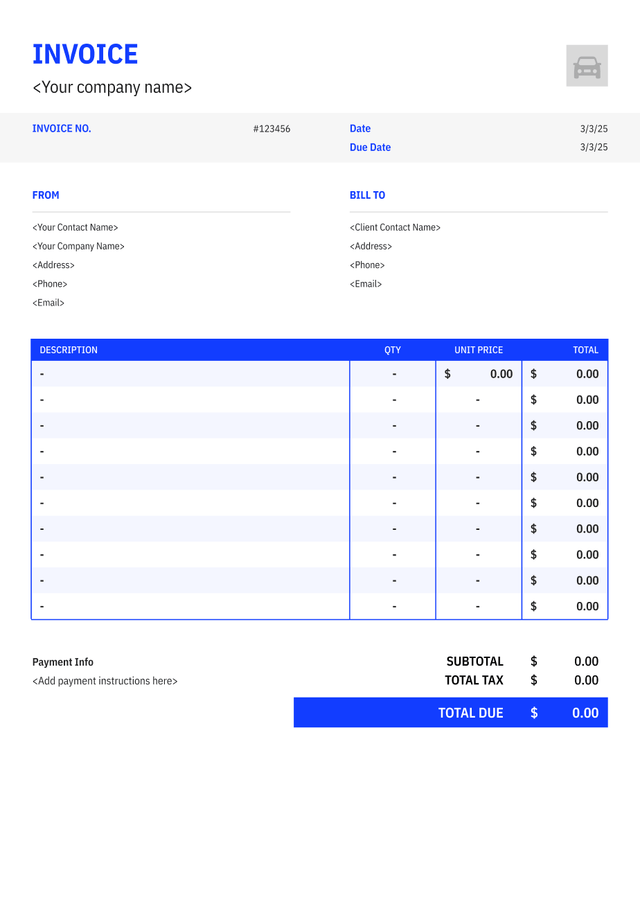
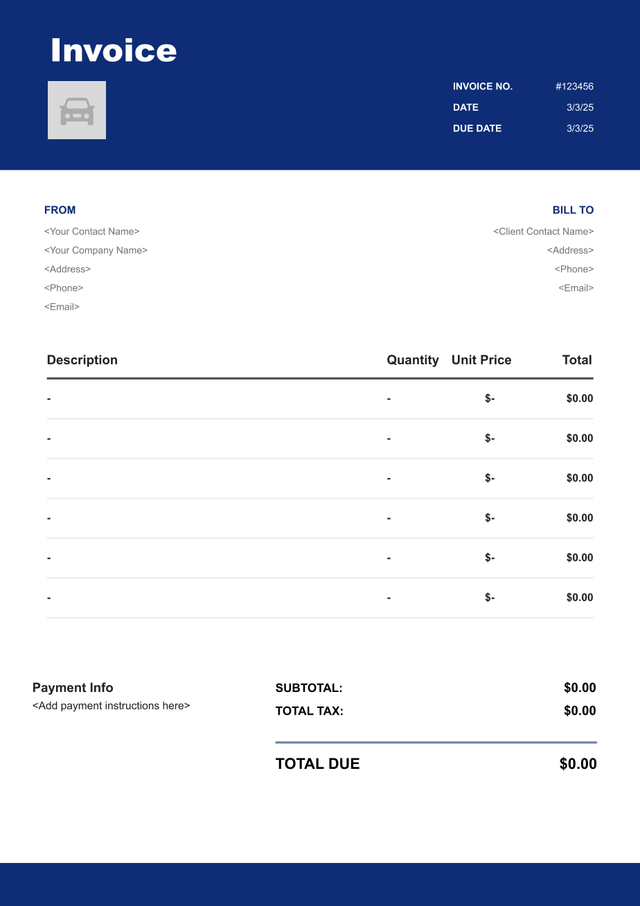
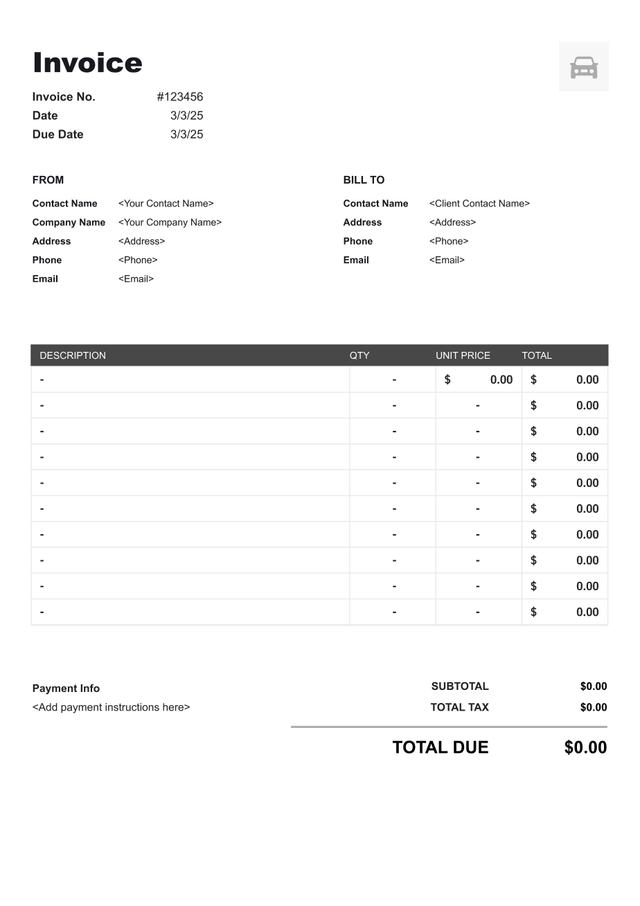
Choose the Right Car Rental Invoice Template


What to Include on a Car Rental Invoice
A car rental invoice should clearly document vehicle, driver, rental, and payment details to help prevent disputes.
1.
Your name, company name,address, phone, email
2.
Client name, address, phone, email
3.
Invoice number, rental agreement number, invoice date and due date
4.
Vehicle information: Includes the make, model, license plate number, VIN, and mileage.
5.
Rental details: Includes the pick-up and return dates and times, as well as the total rental duration.
6.
Billing items:Itemized vehicle rental fees, insurance, fuel, mileage, and additional service charges.
7.
Payment terms: Specifies the payment deadline and any payment instructions.
8.
Subtotal and taxes: Shows the total charges before tax and the total tax amount.
9.
Total due: Shows the final amount the customer must pay.
Common Car Rental Services & Billing Items
How car rental charges are typically structured and billed.
Standard Vehicle Rental
Use of the selected vehicle for the agreed rental period
One-Way Rental
Vehicle picked up at one location and returned at another
Young & Additional Drivers
Rental access for drivers under the age threshold or additional authorized drivers
Insurance & Protection Plans
Optional coverage for vehicle damage and third-party liability
Roadside Assistance
Support for flat tires, jump-starts, lockouts, or towing
Fuel & EV Charging
Refueling or recharging when the vehicle is returned below the agreed level
Toll Management
Tolls incurred during the rental and paid on the customer’s behalf
Late Return
Vehicle returned after the agreed return date or time
Cleaning, Damage & Loss
Cleaning, repairs, or replacement required after the vehicle is returned


Reusable Billing Structure in Invoice Software
Use the items above to quickly create car rental invoices in Invoice Zip.
Common Car Rental Invoicing Mistakes
Avoid common invoicing errors that can lead to customer confusion, payment disputes, or missed charges.
| Mistake | What Goes Wrong | How to Fix |
|---|---|---|
Insurance charges are not itemized | Customers may think they were charged twice for insurance | List each insurance product and rate as a separate line item |
Deposit holds and final charges are combined | Customers may mistake the deposit hold for a duplicate charge | Clearly separate the deposit hold from the final rental charge |
Taxes are not broken down | Customers cannot verify how the total tax was calculated | List each applicable tax and rate separately |
Fuel charges are not itemized | Customers may view the fuel charge as hidden or unexplained | Show the fuel amount, rate, and service fee separately |
Damage claims lack reports or photos | Customers may dispute or refuse to pay damage charges | Attach inspection reports and supporting photos |
One-way fees are not disclosed in advance | Unexpected fees lead to complaints and payment disputes | Show the fee on both the rental agreement and invoice |
Additional driver fees are omitted | Unrecorded drivers may cause billing or liability disputes | Record each authorized driver and applicable fee at signing |
Pre-existing vehicle damage is not recorded | Customers may be charged for damage they did not cause | Inspect the vehicle before pick-up and document existing damage |
Car Rental Invoice Challenges and Solutions
Discover common car rental invoicing challenges and practical ways to improve billing accuracy and resolve disputes.
| Challenge | Solution |
|---|---|
Manual vehicle inspections can miss pre-existing damage or fail to provide evidence for new damage. | Use standardized digital inspection checklists and time-stamped photos at both pick-up and return. |
Tolls, fuel charges, and other surcharges may appear without enough detail, leading to customer complaints and billing disputes. | Itemize each fee with its date, location, amount, and processing charge, and provide a clear dispute process. |
Deposit holds and final charges appear separately, causing customers to believe they were charged twice. | Clearly label the deposit as a temporary authorization and separate it from the final rental charge. |
FAQs about Car Rental Invoicing
Q: How should rental insurance charges appear on the invoice?
Insurance charges should be listed separately from the base rental fee.
- CDW/LDW → show the coverage name, rental days, and daily rate
- Supplemental liability insurance → list as a separate line item
- Example → 3 days × $15/day = $45
Q: How is the fuel charge typically billed?
Fuel charges depend on the fuel policy selected in the rental agreement.
- Full-to-Full → return the vehicle with the same fuel level
- Prepaid Fuel → fuel is purchased before the rental
- Example → 3 gallons × $9/gallon + $25 service fee = $52
Q: How is the EV charging fee calculated?
EV charging fees are usually based on the battery charge missing at return.
- Record the battery level at pick-up and return
- Show any charging service fee separately
- Example → 40 percentage points × $1.20 + $15 service fee = $63
Q: When does a one-way (drop-off) fee apply?
A one-way fee applies when the vehicle is returned to a different location.
- May be charged as a flat fee
- May be calculated based on distance
- Example → Los Angeles to San Diego = $175
Q: How should damage charges appear on the invoice?
Damage charges should clearly identify the damage and supporting evidence.
- Describe each damaged area separately
- Include the repair cost or estimate
- Attach inspection reports and supporting photos
Q: What is the difference between a deposit hold and a final charge?
A deposit hold is temporary, while the final charge is the actual rental amount owed.
- Deposit hold → temporary pre-authorization
- Final charge → amount charged after the rental
- Example → $300 deposit hold released; final charge = $187.50
Q: Why is the toll fee higher than the actual toll amount?
Rental companies may add a processing fee to the actual toll charge.
- Actual toll → charge from the toll operator
- Processing fee → administrative cost for managing the transaction
- Example → $12.50 toll + $15 processing fee = $27.50
Q: How is the additional driver fee calculated?
Additional driver fees are typically charged per authorized driver, per day.
- Record every additional driver on the rental agreement
- Show the number of drivers, rental days, and daily rate
- Example → 1 driver × 4 days × $12/day = $48
Other Free Resources

Try Invoice Zip Today
Start Sending Invoices, Building Reports, Saving Office
Time and Get Paid Faster.