


Operating
Core
Cash from running the business: collections from customers, payroll, rent, suppliers and taxes.
Plan your monthly cash position from your opening balance and expected cash in and out. Get net cash flow, operating and free cash flow, OCF margin, cash runway, ending cash, and a 12-month projection. Separately, estimate how much cash faster invoice collection could release.
Runway is opening cash divided by monthly net burn. With a positive opening balance and no net burn, it is Effectively unlimited under these assumptions. With zero or negative opening cash, it shows No opening cash; estimates of 120 months or more show 120+ months. Aim to keep 2–3 months of operating expenses in reserve; seasonal businesses should target 4–6.
| Month | Cash in | Net cash out | Net | Ending cash |
|---|---|---|---|---|
| Month 1 | $62,000 | $51,500 | $10,500 | $55,500 |
| Month 2 | $62,000 | $51,500 | $10,500 | $66,000 |
| Month 3 | $62,000 | $51,500 | $10,500 | $76,500 |
| Month 4 | $62,000 | $51,500 | $10,500 | $87,000 |
| Month 5 | $62,000 | $51,500 | $10,500 | $97,500 |
| Month 6 | $62,000 | $51,500 | $10,500 | $108,000 |
| Month 7 | $62,000 | $51,500 | $10,500 | $118,500 |
| Month 8 | $62,000 | $51,500 | $10,500 | $129,000 |
| Month 9 | $62,000 | $51,500 | $10,500 | $139,500 |
| Month 10 | $62,000 | $51,500 | $10,500 | $150,000 |
| Month 11 | $62,000 | $51,500 | $10,500 | $160,500 |
| Month 12 | $62,000 | $51,500 | $10,500 | $171,000 |
Assumes the same expected receipts and payments every month. Net cash out = operating payments + CapEx − net financing. Receivables insights below are not included in this forecast.
This separate estimate uses your current unpaid invoices and Days Sales Outstanding (DSO). It does not change net cash flow, ending cash, runway or the 12-month forecast.
Current receivables balance, not monthly revenue.
Enter your average collection time directly.
Potential cash release at 30-day DSO
$76,154$180,000 outstanding · 52-day DSO
Estimated one-time working-capital release, not guaranteed collections or extra monthly revenue.
Cash flow is the money actually moving into and out of your business. Positive cash flow means more arrives than leaves; negative means you're burning reserves. It sounds almost insultingly simple, which is why it gets confused with profit — and that confusion is expensive.
A cash flow statement splits every movement into three sections:
Profit is an accounting result; cash is a fact. You record profit the moment you send an invoice. You get cash when the client actually pays — which, on net-30 terms that drift to 52 days, is a very different moment. A business can post a healthy profit on its P&L and still miss payroll, because the profit is sitting in someone else's accounts-payable queue.
Operating
Cash from running the business: collections from customers, payroll, rent, suppliers and taxes.
Investing
Buying and selling long-lived assets: equipment, vehicles, property and software builds.
Financing
Loans drawn and repaid, equity raised, owner draws and dividends.
Three steps, then the numbers that tell you how long you've got:
Everything that landed in the bank: customer collections, interest received, asset sale proceeds, new loan drawdowns. Use deposits, not invoices.
Everything that left: payroll, rent, suppliers, taxes, loan repayments, equipment purchases, owner draws. Again — actual payments, not bills received.
Net cash flow = in − out. Divide your cash balance by a negative net flow to get runway in months, then roll the balance forward month by month to spot the gap before it arrives.
The calculator groups these same movements into operating cash flow, CapEx and net financing: net cash flow = operating cash flow − CapEx + net financing. Loan drawdowns and repayments are already netted in financing, so this equals total cash in minus total cash out without counting them twice.
Operating cash flow (OCF) = Cash collected − Cash paid for operations
Free cash flow (FCF) = OCF − Capital expenditure
Net cash flow = OCF − CapEx + Net financing
Cash runway (months) = Cash on hand ÷ Monthly net burn
OCF margin = OCF ÷ Cash collected × 100
A 6-person agency opens the month with $45,000 in the bank. Clients pay $62,000; operating costs run $48,000; they buy $2,000 of equipment; and they repay $1,500 of a term loan:
Flip the scenario — collections at $44,000 instead of $62,000 — and net cash flow becomes −$7,500 a month. That's a burn rate, and $45,000 ÷ $7,500 gives a runway of 6 months.

If you invoice for work, your single largest pool of trapped cash is almost always accounts receivable — money you've earned, taxed, and possibly already spent, that's currently sitting in a client's AP system. It doesn't show up as a problem on your P&L. It shows up as a problem on payday.
DSO measures how long it takes, on average, to turn an invoice into cash.
DSO = (Accounts receivable ÷ Total credit sales) × Number of days in the period
Use credit sales and days from the same period to calculate DSO. The Receivables Insights tool uses a simplified approach: enter your DSO in days directly rather than entering credit sales and the reporting period. This separate estimate does not feed into the cash flow forecast.
Rough benchmarks: under 45 days is generally healthy for B2B services, 30 days or less is best-in-class,
and 60+ means you're financing your clients, interest-free, at your own expense. The gap is pure working capital — on $180,000 of receivables, moving from a 52-day DSO to 30 days frees roughly $76,000 of cash without winning a single new client.
A $180,000 receivable balance means very different things depending on how it's distributed:
| Aging bucket | What it usually means | Action |
|---|---|---|
| 0–30 days | Normal course of business — inside your stated terms | None; monitor |
| 31–60 days | Slow AP process, missing PO, or an approver is on holiday | Automated reminder plus a phone call |
| 61–90 days | Dispute, cash-flow trouble at the client, or the invoice went to the wrong approver | Escalate to your champion; confirm delivery and acceptance |
| 90+ days | Serious collection risk; may need write-off | Pause work, formal demand, consider collections |
Anything past 90 days has materially lower recovery odds, and every month it ages is a month it can't fund payroll.
Improve cash flow by collecting money faster, timing payments strategically, and seeing gaps early. Start with these three collection levers, then align your payables and forecast with the cash you expect to have.
Every day between finishing work and sending the invoice is a free day of credit. Send on completion, not on the 1st of next month — batching invoicing can add 15–20 days to DSO on its own.
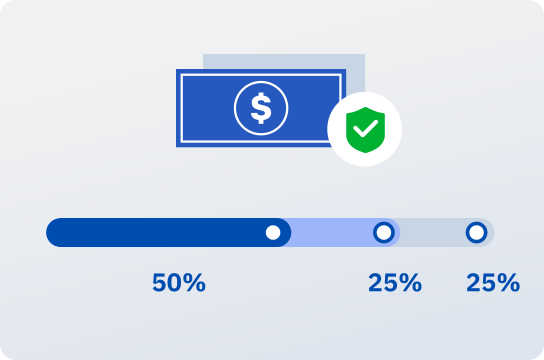
A 40% deposit plus staged payments turns one $30,000 receivable into three collectable chunks, front-loads cash, and de-risks the project.
A pay-now button on the invoice with card and bank transfer options removes the “I'll do it later” step. Reminders before the due date work better than ones after it.

Negotiate net-60 or net-90 with suppliers, and pay on the due date rather than on receipt. Never stretch by paying late.

Update a 13-week cash forecast weekly with actuals against projections. It surfaces shortfalls 8–12 weeks before they hit.
Net cash flow = Operating cash flow + Investing cash flow + Financing cash flow. Operating cash flow is cash collected from customers minus cash paid for operations; free cash flow subtracts capital expenditure.
Profit is an accrual accounting measure recorded when invoiced. Cash flow tracks money actually received and paid. A profitable business can still be cash-flow negative if customers pay slowly.
Free cash flow equals operating cash flow minus capital expenditure. It is the cash left after keeping the business running and funded.
Runway in months equals opening cash divided by monthly net burn. With positive opening cash and no net burn, the calculator shows “Effectively unlimited” under these assumptions. Zero or negative opening cash shows “No opening cash”; estimates of 120 months or more show “120+ months”.
An operating cash flow margin above 15–20% is generally considered healthy. Below that, growth can consume cash faster than it generates it.
Days Sales Outstanding measures the average time to convert an invoice into cash. Every day you shave off DSO releases cash you've already earned.
Two to three months of operating expenses is the standard buffer; seasonal businesses should target four to six. The reserve converts predictable problems — a late client, a slow quarter — into manageable ones rather than emergencies.
It's fast, but expensive. Typical fees of 1–5% per 30 days annualise to roughly 20–45% APR. Exhaust cheaper options first: deposits, shorter terms, faster invoicing, automated reminders, and a business line of credit.
