


FROM NET TO GROSS
VAT Inclusive
- VAT
- = N × r
- Gross price
- = N + VAT = N × (1 + r)
At 20%: £100 × 1.20 = £120 gross
Add VAT to a price or work backward from a VAT-inclusive total. Enter an amount and VAT rate to see the price before tax, the VAT amount, and the total in your chosen currency.
VAT stands for Value Added Tax. It is a consumption tax applied to many goods and services. A VAT rate is the percentage used to calculate the tax on the price before VAT.
A country typically has a standard rate for most taxable sales. It can also apply reduced or zero rates to qualifying supplies. The same product may be taxed differently in different countries.
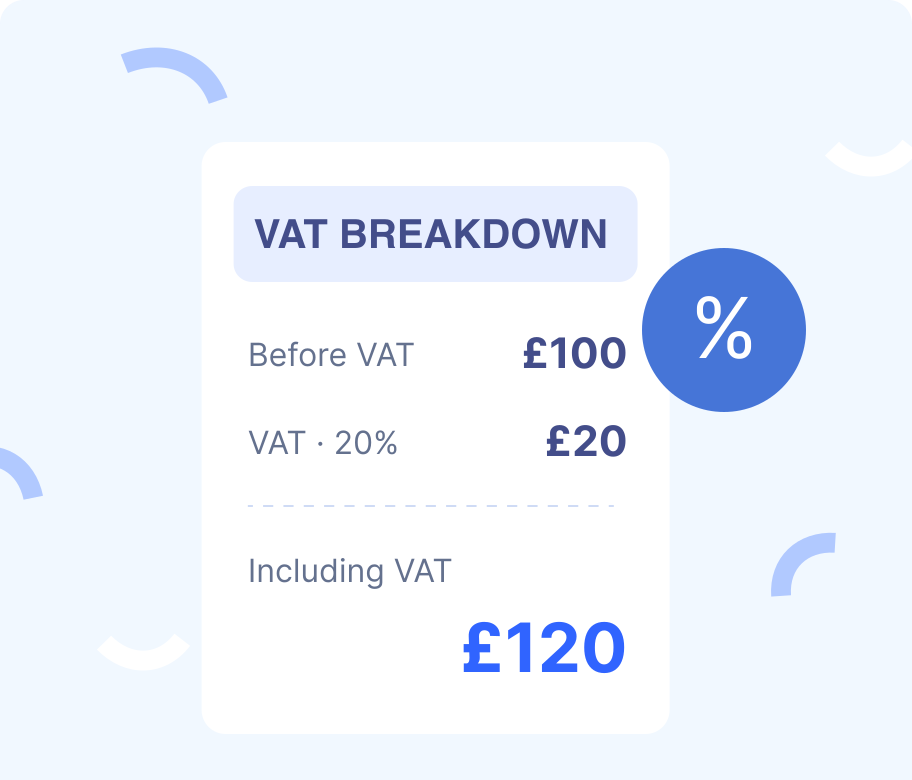
· VAT-registered businesses generally account for VAT on sales and may deduct eligible VAT on business purchases under local rules.
Many countries use VAT. Rates and exceptions vary by country and by what you sell. The table compares standard, reduced, and special rates in selected countries.
| Country and currency | Standard rate | Reduced rates | Special rates | Example or exception |
|---|---|---|---|---|
| United KingdomGBP | 20% | 5% | 0% | Qualifying children’s clothes are zero-rated. Home energy generally qualifies for 5%. Official guidance for United Kingdom |
| BelgiumEUR | 21% | 12%, 6% | 0% | Belgium applies a 0% rate to a limited set of goods and services. Official guidance for Belgium |
| FranceEUR | 20% | 10%, 5.5% | 2.1% | Some supplies in Corsica and overseas territories use different rates. For example, qualifying heat-network subscriptions in Corsica use 2.1%. Official guidance for France |
| GermanyEUR | 19% | 7% | 0% | Qualifying photovoltaic equipment and installation can be zero-rated. Official guidance for Germany |
| IrelandEUR | 23% | 13.5%, 9% | 4.8%, 0% | A separate 4.8% rate applies to qualifying livestock. Some supplies are zero-rated. Official guidance for Ireland |
| ItalyEUR | 22% | 10%, 5% | 4% | A 4% rate can apply to qualifying purchases of a first home. Official guidance for Italy |
| NetherlandsEUR | 21% | 9% | 0% | The 0% rate applies to qualifying exports and some other cross-border transactions. Official guidance for Netherlands |
| Portugal (mainland)EUR | 23% | 13%, 6% | — | Madeira and the Azores have their own rates. Their standard rates are 22% and 16%, respectively. Official guidance for Portugal (mainland) |
| SpainEUR | 21% | 10% | 4% | The Canary Islands, Ceuta and Melilla are outside the Spanish VAT area. Official guidance for Spain |
| SwitzerlandCHF | 8.1% | 2.6% | 3.8% | Qualifying hotel and other overnight accommodation is taxed at 3.8%. Official guidance for Switzerland |
Eligibility for a reduced or zero rate depends on the supply, place of taxation, and transaction date. Check the official guidance linked in the table before applying a rate.
Enter the price using up to two decimal places. Choose the currency at the right of the amount field.
Choose VAT Inclusive to calculate a total with tax from a price before tax. Choose VAT Exclusive to calculate the price before tax from a total that already includes VAT.
Type the rate as a number, such as 20 for 20% or 5.5 for 5.5%. Use the rate that applies to your transaction.
Check the VAT amount, the price before VAT, and the VAT-inclusive total. Select Copy Result to save the breakdown with the currency and rate.
Let N be the price before VAT, G the price including VAT, and r the entered rate divided by 100. For example, 19% becomes 0.19.
FROM NET TO GROSS
At 20%: £100 × 1.20 = £120 gross
FROM GROSS TO NET
At 20%: £120 ÷ 1.20 = £100 net
· Illustrative shortcuts for two rates.
Gross = net × 1.20
Net = gross ÷ 1.20
VAT within gross = gross ÷ 6
Gross = net × 1.05
Net = gross ÷ 1.05
VAT within gross = gross ÷ 21
A VAT-registered supplier normally applies the standard rate unless a reduced rate, zero rate, or exemption covers the supply.
Use the standard rate for the jurisdiction when no other VAT treatment applies.
Use a lower rate when local rules provide one for the supply. The rate can depend on the type of product or service and how it is used.
Use 0% for qualifying zero-rated supplies. These remain taxable sales. Exports can qualify, subject to destination, evidence, and other applicable rules.
Follow the price from net to gross, or work back from a VAT-inclusive amount. These examples use rates from the UK, Germany and Ireland.

EXAMPLE 01 · UK · STANDARD RATE
VAT = £60.00 × 0.20
Total = £60.00 + £12.00
Including VAT
£72.00EXAMPLE 02 · UK · REDUCED RATE
VAT = £200.00 × 0.05
Total = £200.00 + £10.00
Including VAT
£210.00
EXAMPLE 03 · GERMANY · STANDARD RATE
Net = €119.00 ÷ 1.19
VAT = €119.00 − €100.00
Before VAT
€100.00
EXAMPLE 04 · IRELAND · REDUCED RATE
Net = €227.00 ÷ 1.135
VAT = €227.00 − €200.00
Before VAT
€200.00These examples show VAT within a price. Eligibility to reclaim that VAT depends on the purchase and the business’s circumstances.
These UK examples show which expenses a VAT-registered business can review. Keep valid VAT invoices and evidence of business use. Check local recovery rules for other countries.

Review VAT charged on business phone costs. For mixed personal and business use, apply the relevant business-use allocation and retain supporting records. Employer-provided phones have specific rules.

Check VAT on utilities used partly for business. Base any claim on a supportable business proportion. Broadband recovery depends on who contracts for the service and how it is used.

Review VAT on fuel used for business travel. Keep mileage records and the required fuel receipts. For employee mileage payments, only the fuel element is relevant to the VAT calculation.

Check invoices for VAT-bearing subscriptions or resources used for taxable business activities. Some memberships are exempt and some publications are zero-rated. Insurance transactions are generally VAT-exempt, so the premium does not normally contain VAT to reclaim.
Rates vary by country and by what you sell. For example, Germany’s standard rate is 19% and the Netherlands’ standard rate is 21%, even though both use euros.
Net is the price before VAT. Gross is the price including VAT. The VAT amount is the difference between the two.
Multiply the price before VAT by 1 plus the applicable rate as a decimal. For example, at 19%, €100 × 1.19 gives €119 including VAT.
Divide the VAT-inclusive amount by 1 plus the applicable rate as a decimal to find the price before VAT. At 19%, divide by 1.19. Subtract the price before VAT from the total to find the VAT amount.
The calculator updates the currency symbol on your results. It keeps the amount and VAT rate you entered, so enter the price in the currency you choose.
Zero-rated supplies are taxable at 0%. Exempt supplies have separate rules and generally restrict recovery of VAT on related costs.
Registration requirements depend on the jurisdiction, the business and the transactions it makes. Check the applicable tax authority for the threshold and effective date.
Recovery depends on the purchase, evidence, business use, taxable activities, and any scheme or restriction that applies. A VAT amount shown by the calculator is only the tax component of the price.
Calculate each rate group separately and combine the results using the rounding method applicable to the invoice.
It rounds the VAT amount to two decimal places, rounding half a cent or penny up, then derives the corresponding net or gross price from the input.