


Carpentry Invoice Template
Designed for carpentry businesses, custom furniture makers, and woodworking contractors.
Choose the Right Carpentry Invoice Template
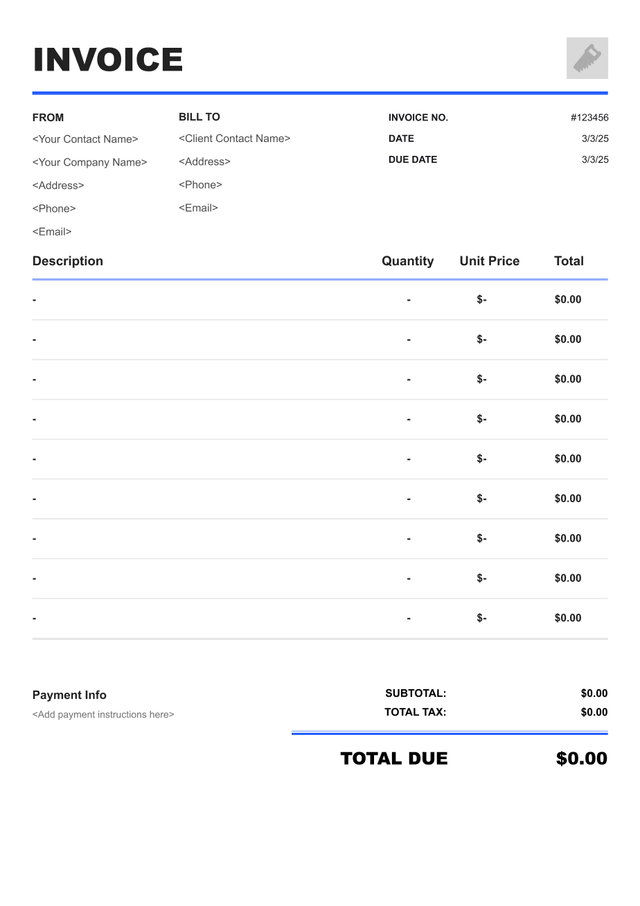


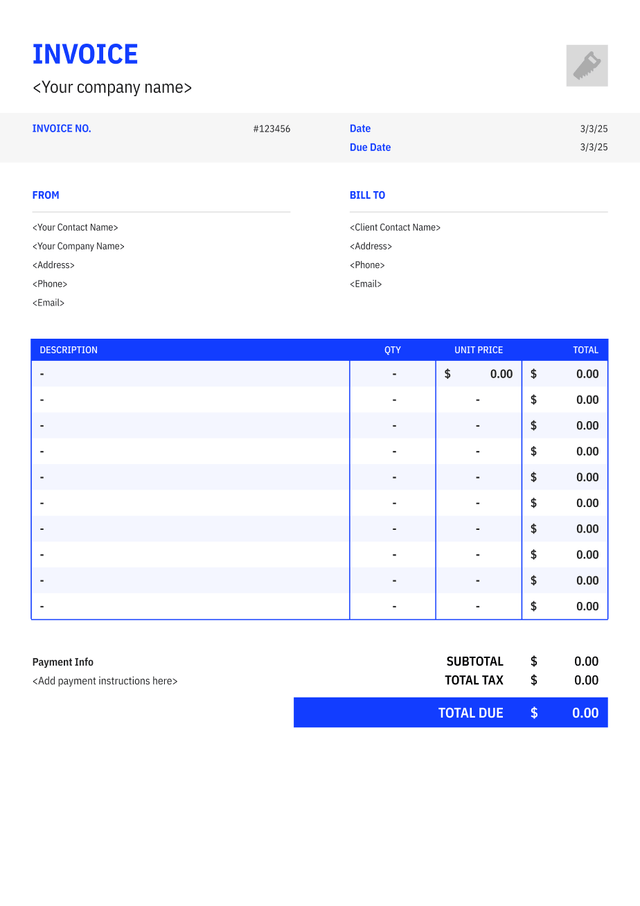
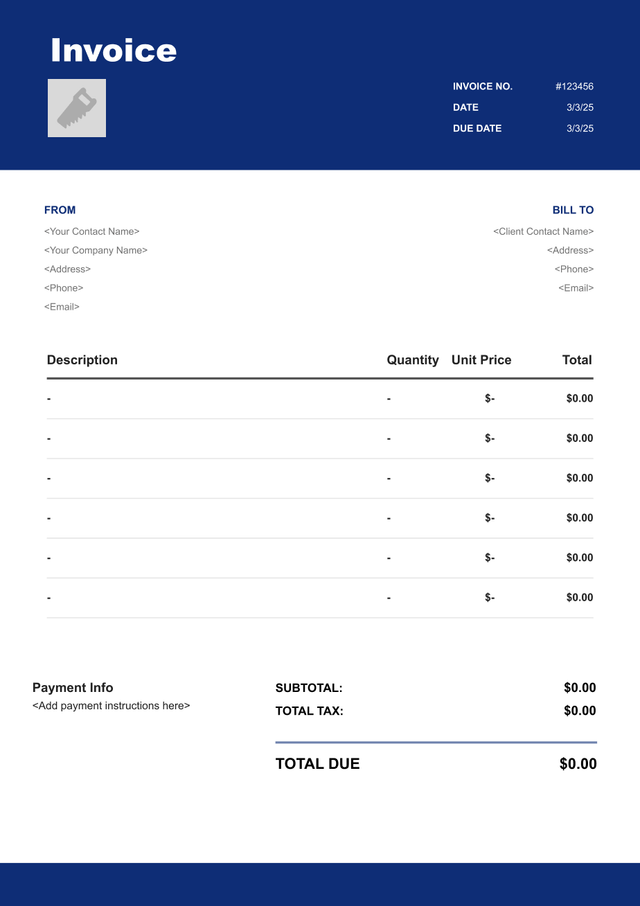
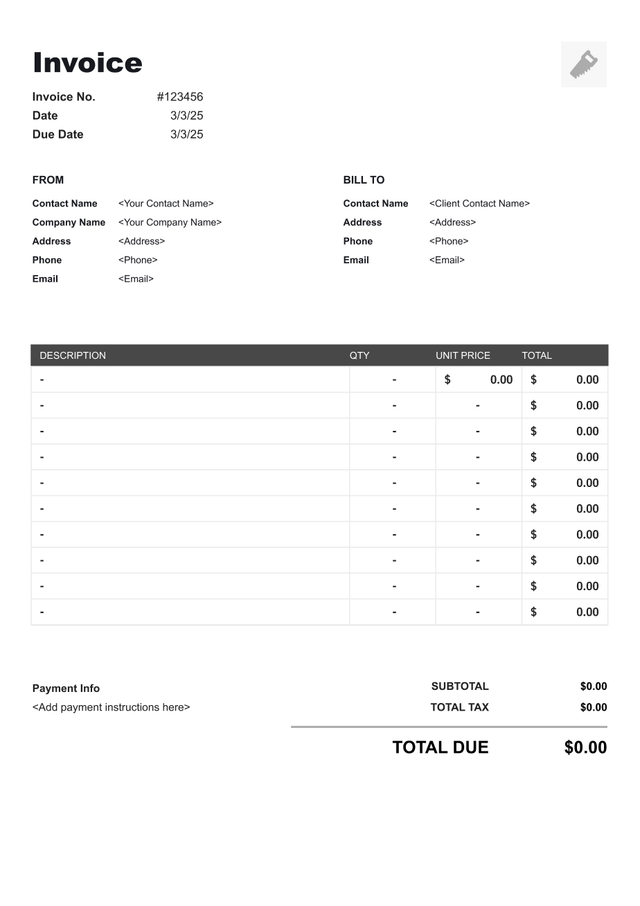
What to Include on a Carpentry Invoice
A carpentry invoice should clearly document project details, labor, materials, approved changes, and payment information to help prevent billing disputes.
1.
Business information: Includes the company name, address, phone number, and email.
2.
Client information: Includes the client’s name, address, phone number, and email.
3.
Invoice and project details: Includes the invoice number, project name, job site address, and service date or date range.
4.
Carpenter and crew information: Identifies the carpenters or crew members assigned to the project.
5.
Materials and labor details: Lists the wood, hardware, specifications, model numbers, and labor hours recorded by day or task.
6.
Deposit and change order records: Shows the deposit collected and references any approved changes to the original project scope, work order, or estimate.
7.
Billing items: Itemizes labor, materials, and any additional carpentry service charges.
8.
Payment terms: Specifies the payment deadline and any payment instructions.
9.
Subtotal and taxes: Shows the total charges before tax and the total tax amount.
10.
Total amount due: Shows the final amount the client must pay.
Common Carpentry Services & Billing Items
How carpentry services are typically structured and billed.
Custom Furniture Making
Design and construction of custom furniture based on the client's specifications
Cabinet Installation
Installation of kitchen, bathroom, or built-in cabinetry
Wood Flooring Installation
Installation of hardwood or engineered wood flooring
Door & Window Installation
Installation or replacement of interior and exterior doors and windows
Trim & Molding Installation
Installation of baseboards, crown molding, casing, and decorative trim
Deck & Fence Construction
Construction or replacement of wooden decks, railings, and fences
Carpentry Repair & Restoration
Repair or restoration of damaged wooden structures and components
Custom Shelving & Built-Ins
Design and installation of custom shelves, storage units, and built-in furniture
Emergency & Rush Carpentry Service
Expedited scheduling, urgent repairs, or accelerated project completion


Reusable Billing Structure in Invoice Software
Use the items above to quickly create carpentry invoices in Invoice Zip.
Common Carpentry Invoicing Mistakes
Common invoicing errors and how to avoid them in real-world carpentry projects.
| Mistake | What Goes Wrong | How to Fix |
|---|---|---|
Materials and labor are not separated | Clients cannot verify individual costs and may question the total charge | List labor, materials, hardware, and additional fees as separate line items |
Labor hours are not recorded | Missing or inaccurate hours can lead to underbilling and payment disputes | Record hours worked each day by carpenter, task, or project stage |
Project changes are not confirmed | Additional work increases the final invoice and makes payment difficult to collect | Use a signed change order before starting any work outside the original scope |
Material specifications are not listed | Clients cannot verify the type, grade, or quality of materials used | Include the exact material type, grade, quantity, or model number |
Deposit records are missing | Clients may think they were charged twice, and financial reconciliation becomes difficult | Show the deposit date and amount separately from the remaining balance |
Project and job site details are unclear | Clients cannot easily connect the invoice to the completed carpentry work | Include the project name, job site address, and service dates |
Additional fees are not itemized | Clients cannot understand how the final amount was calculated | List permit fee, delivery fee, or other charge separately |
Payment terms are unclear | Missing deadlines or payment instructions can delay payment | Clearly state the due date, payment schedule, and accepted payment methods |
Carpentry Invoice Challenges and Solutions
Discover common carpentry invoicing challenges and practical ways to improve pricing accuracy, protect cash flow, and reduce payment disputes.
| Challenge | Solution |
|---|---|
Pricing is difficult before work begins because labor, material markups, overhead, and profit margins are easy to underestimate. | Calculate labor, materials, overhead, and profit separately, then provide a clear fixed price or hourly estimate before work begins. |
Clients may cancel, stop responding, or request additional work after the project starts, leaving the carpenter with unpaid labor and material costs. | Collect an agreed deposit before starting work and require a signed change order for every change in scope, dimensions, or materials. |
Clients may view the final invoice as overpriced or dispute when payment is due if charges, milestones, and acceptance terms are unclear. | Itemize labor, materials, transportation, and additional fees, and clearly define payment milestones and acceptance criteria in the contract and final invoice. |
FAQs about Carpentry Invoicing
Q: How are carpentry projects typically billed?
Carpentry projects may be billed by project, labor hours, units, or area, depending on the type of work.
- Custom work → usually billed at a fixed project rate
- Repair work → often billed hourly
- Flooring or paneling → may be billed by square foot
- Example → Custom bookshelf, flat project rate = $850
Q: Should material costs be listed separately?
Yes. Listing materials separately improves transparency and helps clients understand each charge.
- Identify the material type and quantity
- Show material and labor costs as separate line items
- Example → Lumber and materials = $320; labor: 8 hours × $65/hour = $520
Q: How should custom furniture be quoted?
Custom furniture is typically quoted based on its dimensions, materials, design complexity, and required labor.
- Specify the furniture dimensions and material type
- Estimate material costs and labor separately
- Include hardware, finishing, or delivery fees when applicable
- Example → Hardwood materials: 18 sq. ft. × $45 = $810; labor: 12 hours × $65 = $780; total = $1,590
Q: How are project changes billed?
Changes to the original project scope should be documented and approved before additional work begins.
- Describe the requested change
- Show the additional materials, labor, and cost
- Reference the signed change order on the invoice
- Example → Change Order #2: Added shelving unit = $180
Q: How should a deposit appear on the invoice?
The deposit should be shown as a separate line item and deducted from the project total.
- Record the deposit amount and payment date
- Clearly distinguish the deposit from the final payment
- Show the remaining balance due
- Example → Project total = $1,000; deposit paid = $400; balance due = $600
Q: Is it necessary to track labor hours?
Labor hours should be tracked for repair work and any project billed hourly.
- Record the carpenter’s name and hours worked
- Include the service date, task, and hourly rate
- Show overtime separately when applicable
- Example → Repair labor: 3.5 hours × $65/hour = $227.50
Q: Should tax be shown separately on the invoice?
Yes. The applicable tax rate and tax amount should be displayed separately from labor and project charges.
- Show the taxable subtotal
- State the applicable tax rate
- Display the calculated tax as a separate amount
- Example → Taxable subtotal: $750 × 8% tax = $60; total = $810
Q: How can final payment disputes be avoided?
Clearly define payment milestones and acceptance criteria before the project begins and reference them on the invoice.
- State when each payment is due
- Define the project completion and acceptance requirements
- Record deposits and progress payments separately
- Example → Milestone 1: Deposit = $500; Milestone 2: Completion and acceptance = $700
Other Free Resources

Try Invoice Zip Today
Start Sending Invoices, Building Reports, Saving Office
Time and Get Paid Faster.