

Types of Invoices
10min read
|
Aug 28, 2026
There are many types of invoices, but they are not all used equally. For most small businesses, standard, sales, and service invoices cover everyday billing. Recurring invoices are common for ongoing services, while deposit, progress, and timesheet invoices are more common in specific types of businesses. Other types are mainly used for particular transactions, industries, or billing arrangements.
The main differences come down to when you bill, what you're billing for, and how the amount is calculated or adjusted.
Common Types of Invoices
There are many names for different invoices, but the most common ones are fairly straightforward.
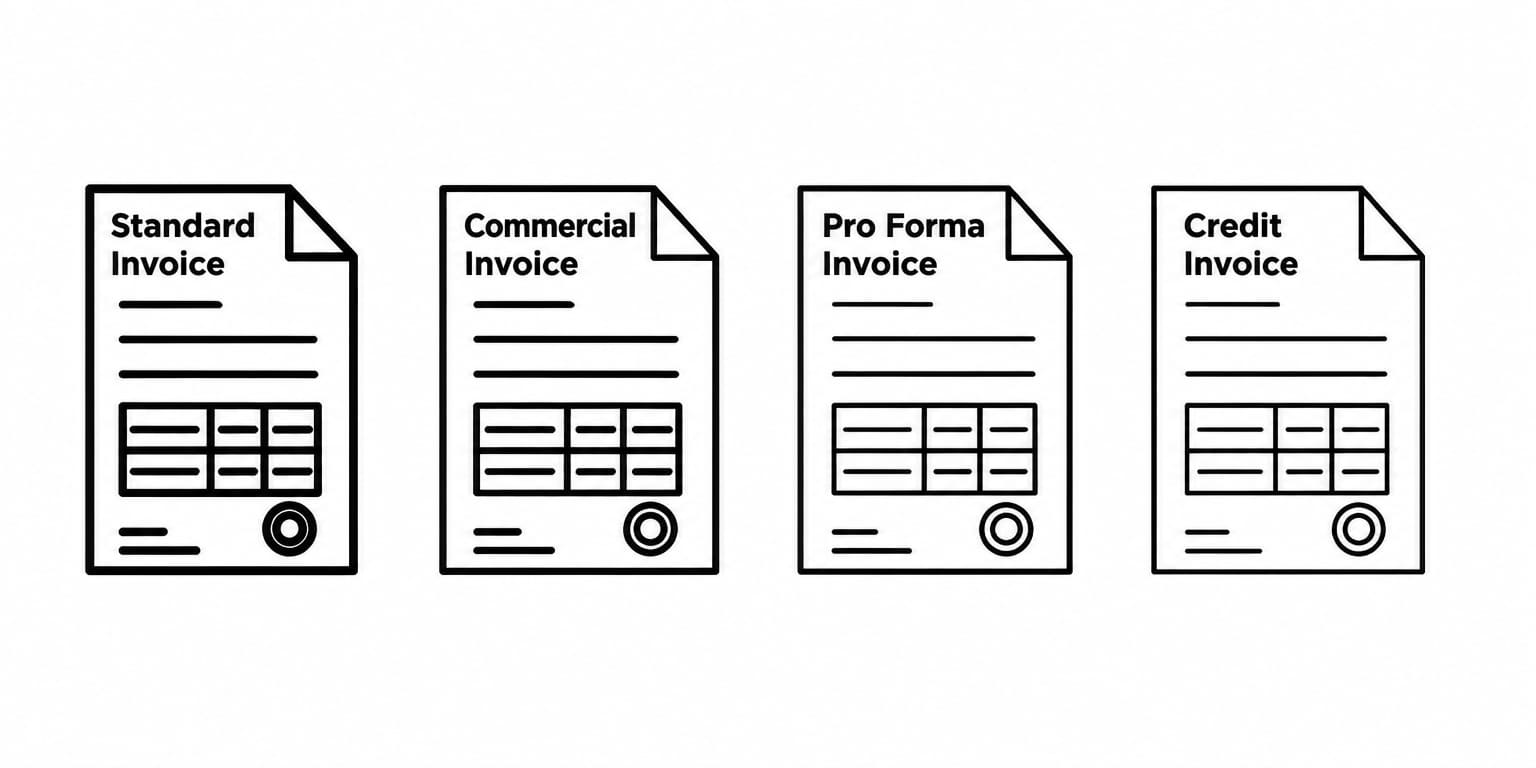
1. Standard Invoice
A standard invoice is the basic invoice used to request payment for products or services.
A contractor can send one after finishing a job. A designer can use one after completing a project. A supplier can send one after delivering an order.
A standard invoice usually includes the business and customer information, invoice number, invoice date, description of the products or services, amount due, payment terms, and due date.
For most small businesses, this is the invoice type used most often.
2. Sales Invoice
A sales invoice records a sale and shows the buyer what they owe.
In many businesses, a sales invoice is simply a standard invoice for a product sale. The term is more common when a business sells physical goods or handles a large number of sales transactions.
For example, a furniture supplier sells a $4,000 order to a local business. The supplier sends a sales invoice listing the products, quantities, prices, taxes, and total amount due.
3. Service Invoice
A service invoice is used when a business charges for work rather than a physical product.
A plumber may list labor and parts. A consultant may bill for a project. A freelance writer may charge by the article or by the hour.
The main difference is in how the work is described and priced. A service invoice should give the customer enough detail to understand what they are paying for.
4. Commercial Invoice
A commercial invoice is used for international shipments of goods.
It contains information about the transaction and the goods being shipped, which can be used for customs purposes. Depending on the shipment, it may include the seller, buyer, product descriptions, quantities, values, currency, and country of origin.
A small business that only provides local services will probably never use one. An online seller shipping products internationally may use commercial invoices regularly.
Types of Invoices Based on When You Bill
Some invoice types are defined mainly by when payment is requested.
5. Pro Forma Invoice
A pro forma invoice is prepared before a transaction is finalized or goods are shipped. It shows what the transaction is expected to look like, including products, quantities, prices, shipping, and other expected charges.
For example, an exporter may send a customer a pro forma invoice for a shipment before the final sale is completed.
The customer can use it to review the transaction or prepare for the expected costs.
A pro forma invoice is generally not the same as a final invoice. It is more of a preliminary document than a final request for payment.
6. Deposit Invoice
A deposit invoice requests an upfront payment before work begins.
This is common when a business needs to reserve time, purchase materials, or commit resources to a project.
Suppose a contractor agrees to a $10,000 renovation and requires a 30% deposit. The contractor can send a deposit invoice for $3,000 before starting the work.
The remaining $7,000 can be billed later.
7. Interim Invoice
An interim invoice bills part of a project before the entire project is finished.
This is useful for projects that take weeks or months. The business can collect money during the project instead of waiting until everything is complete.
For example, a $30,000 project might be divided into three $10,000 payments.
The payment schedule should be agreed upon before the project starts so both sides know when each invoice will be issued.
8. Progress Invoice
A progress invoice is similar to an interim invoice, but the amount is usually tied to the progress of the work.
A construction company might invoice 30% of the contract after completing the first major stage of a project. Another invoice might follow after the next stage.
Progress invoices are particularly useful when the amount of work completed can be measured clearly.
9. Milestone Invoice
A milestone invoice is issued when a specific project milestone is reached.
For example, a software development project might have payment points for:
- Initial design approval
- Prototype completion
- Development completion
- Final launch
- The invoice is tied to the agreed milestone rather than simply to a calendar date.
- The difference between milestone and progress billing can be small. A progress invoice usually reflects how much of the project has been completed, while a milestone invoice is tied to a specific deliverable or event.
10. Final Invoice
A final invoice is issued when the final stage of a project or engagement is complete.
If the customer has already paid a deposit or previous installments, the final invoice should show those payments and the remaining balance.
For example:
| Description | Amount |
|---|---|
| Total project price | $20,000 |
| Deposit paid | -$5,000 |
| Progress payment | -$7,000 |
| Balance Due | $8,000 |
The customer can see exactly how the final balance was calculated.
Types of Invoices for Recurring and Time-Based Billing
Some businesses don't bill customers just once. They charge on a regular schedule or base the amount on the actual time spent working.
11. Recurring Invoice
A recurring invoice is sent on a regular schedule.
Common examples include:
- Monthly bookkeeping
- Website maintenance
- Cleaning services
- Consulting
- Memberships
- Ongoing maintenance
- If a business charges $500 every month for bookkeeping, it can create a recurring invoice schedule rather than preparing a new invoice manually every month.
- Recurring invoices are one of the more useful types for businesses with predictable, repeat billing.
12. Retainer Invoice
A retainer invoice is used when a customer pays in advance for ongoing services, availability, or a defined amount of work.
A lawyer might charge a monthly retainer. A marketing consultant might charge $2,000 for ongoing support.
The invoice itself does not define what the retainer covers. That should be established in the agreement.
For example, the agreement might specify that the $2,000 retainer covers up to 20 hours of work each month, with additional hours billed separately.
13. Timesheet Invoice
A timesheet invoice is based on hours worked.
It is common among freelancers, consultants, contractors, agencies, and other businesses that bill hourly.
For example:
| Work | Hours | Rate | Amount |
|---|---|---|---|
| Client meetings | 3 | $75 | $225 |
| Design work | 12 | $75 | $900 |
| Revisions | 4 | $75 | $300 |
| Total | 19 | $1,425 |
Instead of simply showing a $1,425 labor charge, the invoice gives the customer a breakdown of the work.
That makes the invoice easier to review and gives the customer a clear record of how the total was calculated.
Types of Invoices Used for Adjustments and Multiple Transactions
Not every invoice-related document is created to bill a new transaction. Some are used to change an existing balance or combine multiple transactions.
14. Credit Invoice
A credit invoice, often called a credit memo or credit note, reduces the amount a customer owes.
It may be used when:
- A customer returns a product
- An invoice contains an overcharge
- A service is cancelled
- A discount is applied after the original invoice
- Part of an invoice needs to be reversed
- For example, a business sends a $2,000 invoice and later discovers that $300 was charged incorrectly. A $300 credit can reduce the customer's balance to $1,700.
- Keeping the adjustment separate creates a clearer record than simply changing the original invoice.
15. Debit Invoice
A debit invoice increases the amount a customer owes.
Suppose a contractor sends a $5,000 invoice. The customer then approves another $500 of work that was not included in the original agreement.
A debit adjustment can document the additional $500.
The basic distinction is:
Credit → decreases the balance
Debit → increases the balance
The terminology can vary between accounting systems, so the exact way these adjustments are recorded may differ.
16. Consolidated Invoice
A consolidated invoice combines several transactions into one invoice.
For example, a supplier might make ten deliveries to the same customer during one month. Instead of sending ten separate invoices, the supplier can combine those transactions into one monthly invoice if the billing arrangement allows it.
This is particularly useful when a customer makes frequent purchases.
It can reduce paperwork and make payment easier to track.
17. Self-Billing Invoice
A self-billing invoice is created by the buyer rather than the seller under an agreed arrangement.
For example, a large company may calculate what it owes a supplier based on completed deliveries and prepare the invoice itself.
This is more specialized than normal invoicing. It generally requires an arrangement between the buyer and seller and may be subject to specific rules.
A small business should not assume that it can simply switch to self-billing because it seems easier.
Specialized Types of Invoices
Some invoice types appear mainly because of a particular industry, tax system, transaction, or payment status.
18. Tax Invoice
A tax invoice contains information required for tax purposes under a particular tax system.
Depending on the jurisdiction, that can include a tax registration number, tax rate, tax amount, and other information.
The requirements are not the same everywhere. A business should check the rules that apply to its location and type of transaction.
19. Past-Due Invoice
A past-due invoice is an invoice that has passed its payment deadline without being paid in full.
It is usually not a completely new type of invoice. It is the original invoice with an overdue status.
For example:
Invoice #1042
Amount Due: $1,200
Due Date: August 15
Status: Past Due
The business can then send a reminder or follow its normal collection process.
Keeping the original invoice number and balance visible is useful when following up with the customer.
20. E-Invoice
An e-invoice is an invoice handled electronically.
The term can mean more than simply emailing a PDF. In some contexts, an e-invoice is structured digital data that can be transmitted and processed automatically through an electronic invoicing system.
That makes it different from simply creating a PDF invoice and attaching it to an email.
The exact definition and requirements depend on the system and jurisdiction involved.
How to Choose the Right Invoice Type
The right type usually becomes obvious once you look at how the transaction works.
| If You... | Consider Using |
|---|---|
| Bill for a normal sale or service | Standard Invoice |
| Sell physical products | Sales Invoice |
| Provide a service | Service Invoice |
| Need to show expected transaction details | Pro Forma Invoice |
| Collect money before starting work | Deposit Invoice |
| Bill during a long project | Interim or Progress Invoice |
| Bill when a specific deliverable is completed | Milestone Invoice |
| Collect the remaining project balance | Final Invoice |
| Charge customers on a regular schedule | Recurring Invoice |
| Collect payment in advance for ongoing services | Retainer Invoice |
| Charge based on hours worked | Timesheet Invoice |
| Ship products internationally | Commercial Invoice |
| Need to reduce an existing charge | Credit Invoice |
| Need to add an additional charge | Debit Invoice |
| Combine multiple transactions | Consolidated Invoice |
| Bill under a buyer-created arrangement | Self-Billing Invoice |
| Need specific tax information | Tax Invoice |
| Customer has missed the payment deadline | Past-Due Invoice |
| Send invoices through a structured electronic system | E-Invoice |
There is some overlap between these categories.
A monthly consulting invoice could be both a recurring invoice and a tax invoice. A construction project could use a deposit invoice, several progress invoices, and a final invoice. A business could also issue any of those electronically.
The names aren't always mutually exclusive. They describe different aspects of the billing process.
For a typical small business, the most frequently used types will usually be standard, sales, service, recurring, deposit, progress, timesheet, and final invoices, depending on the business model. Commercial, self-billing, tax, and other specialized invoices tend to come up only when a particular transaction calls for them.
The important part is that the invoice matches the transaction. A simple service should not require a complicated billing document, while a large project may need several invoices to keep payments and work on track.
Most Popular Pages


Try Invoice Zip Today
Start Sending Invoices, Building Reports, Saving Office
Time and Get Paid Faster.