


What is a Remittance Address
6min read
|
Sep 11, 2026
A remittance address is the address where a business asks customers to send payments, such as checks or other payment-related correspondence. It may be the company's regular business address, a separate accounting address, or a payment processing location.
You may see a remittance address on an invoice under labels such as "Remit To", "Remittance Address", or "Payment Address".
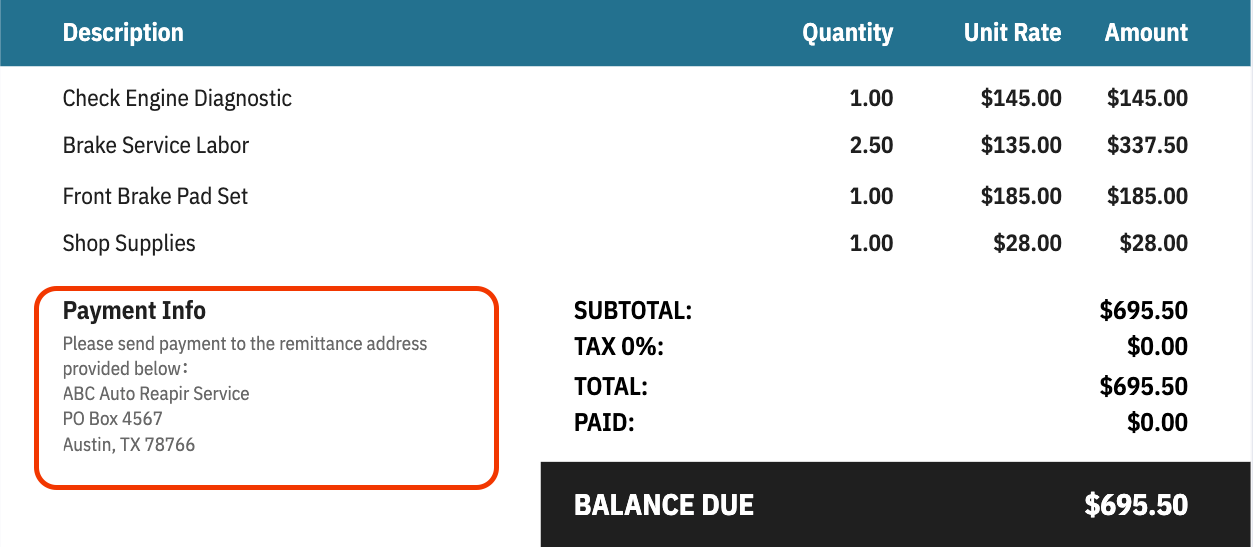
Including the correct remittance address helps customers know where to send payments and can reduce delays caused by checks or payment documents being sent to the wrong location.
What Is a Remittance Address Used For?
A remittance address tells customers where to send payments when the payment destination is different from the business's primary address or when the business wants to clearly identify the payment-processing location.
A business may use a remittance address for:
- Receiving checks
- Processing customer payments
- Receiving payment-related correspondence
- Directing payments to an accounting or finance department
- Separating payment processing from the company's main office
For example, a company may have its main office in Los Angeles but process customer payments through an accounting office in another city. The invoice can show the accounting office as the remittance address.
A typical invoice might display:
Remit To:
ABC Services
123 Main Street
Los Angeles, CA 90001
The customer can then use this address when sending a check or other payment by mail.
Not every business needs a separate remittance address. If payments are sent to the same address as the company's regular business address, the business may simply use that address for both purposes.
Remittance Address vs. Billing Address
Remittance address and billing address are sometimes confused because both can appear on invoices and other financial documents. However, they serve different purposes.
A remittance address identifies where the customer should send a payment.
A billing address generally refers to the address associated with the customer or the billing record for a transaction. It can be used to identify the party being billed and may also be used for payment verification or account records.
For example, an invoice might contain:
Bill To:
John Smith
456 Oak Street
San Diego, CA 92101
Remit To:
ABC Services
123 Main Street
Los Angeles, CA 90001
In this example, the Bill To section identifies the customer receiving the invoice, while the Remit To section tells the customer where to send payment.
The two addresses can belong to different parties and serve different purposes.
| Address | Purpose |
|---|---|
| Remittance address | Tells the customer where to send payment |
| Billing address | Identifies the customer or billing information associated with the transaction |
| Business address | Identifies the company's primary business location |
The exact way these addresses are used can vary between businesses and payment systems. The important thing is to make the purpose of each address clear.
Where to Put a Remittance Address on an Invoice
A remittance address is commonly placed in the invoice's payment or contact information section.
You can label it clearly as:
- Remit To
- Remittance Address
- Payment Address
For example:
Remit To:
ABC Consulting
PO Box 12345
Dallas, TX 75201
If the customer is expected to mail a check, placing the remittance address near the payment instructions can make it easier to find.
For invoices that support multiple payment methods, you can also include the remittance address alongside other payment information.
For example:
Payment Information
Check: Mail payment to:
ABC Consulting
PO Box 12345
Dallas, TX 75201
Online: Pay through the available online payment option.
This makes it clear that the remittance address applies specifically to mailed payments.
Do You Need a Remittance Address on an Invoice?
No, not every invoice needs a separate remittance address.
If customers send payments directly to the business's normal address, you may not need to create a separate Remit To section. You can provide the appropriate payment address as part of your regular business or payment information.
A separate remittance address can be useful when:
- Payments are processed at a different location
- The business uses a PO box for mailed payments
- An accounting department handles incoming payments
- The company has multiple offices
- Payments are sent to a lockbox or payment-processing service
- The business wants to separate payment mail from general correspondence
For example, a company may have a physical office where customers visit but use a PO box specifically for receiving checks. In this situation, putting the PO box on invoices helps ensure payments are sent to the correct location.
The most important requirement is accuracy. An outdated or incorrect remittance address can delay payment and create unnecessary follow-up with customers.
How to Add a Remittance Address to an Invoice
If your business uses a separate payment address, adding it to an invoice is straightforward.
Determine Where Payments Should Be Sent
Decide which address should receive customer payments. This may be your business address, PO box, accounting office, or another payment-processing location.
Confirm the Address
Check the street address, PO box number, city, state, and ZIP code before adding the information to your invoice template.
Use a Clear Label
Use a familiar label such as "Remit To" or "Remittance Address" so customers immediately understand what the address is for.
Add Payment Instructions
If necessary, explain how the customer should use the address. For example, you can specify that checks should be mailed to the remittance address.
Keep the Information Updated
If your payment-processing address changes, update your invoice template and make sure new invoices contain the correct information.
Using a consistent invoice template can help prevent different versions of the remittance address from being used.
Remittance Address Example on an Invoice
Here is a simple example of how a remittance address can appear on an invoice:
ABC Design Studio
123 Market Street
Austin, TX 78701
Invoice #: INV-1025
Invoice Date: September 8, 2026
Due Date: October 8, 2026
Bill To:
XYZ Company
456 Congress Avenue
Austin, TX 78701
Services:
Website design — $1,200
Total Due: $1,200
Remit To:
ABC Design Studio
PO Box 4567
Austin, TX 78766
In this example, the business address and remittance address are different. The customer can use the Remit To information when sending a payment by mail.
If payments are made electronically, the invoice can also include the relevant online payment instructions instead of relying only on a mailing address.
Common Questions About Remittance Addresses
Is a remittance address the same as a business address?
Not necessarily. A business can use its regular business address as its remittance address, but it may also use a separate address for receiving payments.
Is a remittance address the same as a billing address?
No. A remittance address generally tells the customer where to send payment, while a billing address is associated with the customer or billing information for the transaction.
Can a business have more than one remittance address?
Yes. A business with multiple locations, payment-processing centers, or customer accounts may use different payment addresses. In these cases, the invoice should clearly identify which address applies to the specific payment.
What does "Remit To" mean on an invoice?
"Remit To" means the address or payment destination where the customer should send payment. It is commonly used as a shorter label for a remittance address.
Should a remittance address be included on every invoice?
Not necessarily. If the payment address is already clear and the same as the business address, a separate remittance address may not be needed. However, including a clearly labeled payment address can make invoices easier for customers to process.
Final Thoughts
A remittance address tells customers where to send payments. It may be the same as the business address, but businesses can also use a separate PO box, accounting office, or payment-processing location.
For clear invoices, use a recognizable label such as "Remit To", provide the complete payment address, and make sure the information stays accurate.
When a business uses a separate remittance address, clearly displaying it on invoices can help customers send payments to the right place and avoid unnecessary payment delays.
Most Popular Pages



Try Invoice Zip Today
Start Sending Invoices, Building Reports, Saving Office
Time and Get Paid Faster.