

How to Identify Your Most Valuable Customers
5min read
|
Aug 28, 2026
When you only have a few customers, it is easy to know who your best customers are. You probably remember who buys from you most often, who brings in the most sales, and who you can count on to pay.
As your business grows, it becomes harder to keep track of all of this from memory. You may have dozens of customers and hundreds of invoices, making it difficult to compare customers or see which relationships are contributing the most to your business.
Instead of relying on memory, you can use your sales and invoice data to get a clearer picture. Looking at sales by customer, invoice history, and outstanding balances can help you identify your most valuable customers and decide which relationships deserve more attention.
Start by Comparing Sales by Client
The easiest place to start is with your sales by customer.
If you only have a few customers, you could add up their invoices manually. But once you have more customers and invoices, doing this one customer at a time takes unnecessary work.
A Sales by Client report gives you a summary of how much each customer has contributed to your sales.
In Invoice Zip, open Reports and select Sales by Client. The report groups your sales by client and shows the Sub Total, Tax, Total, and Paid amount.
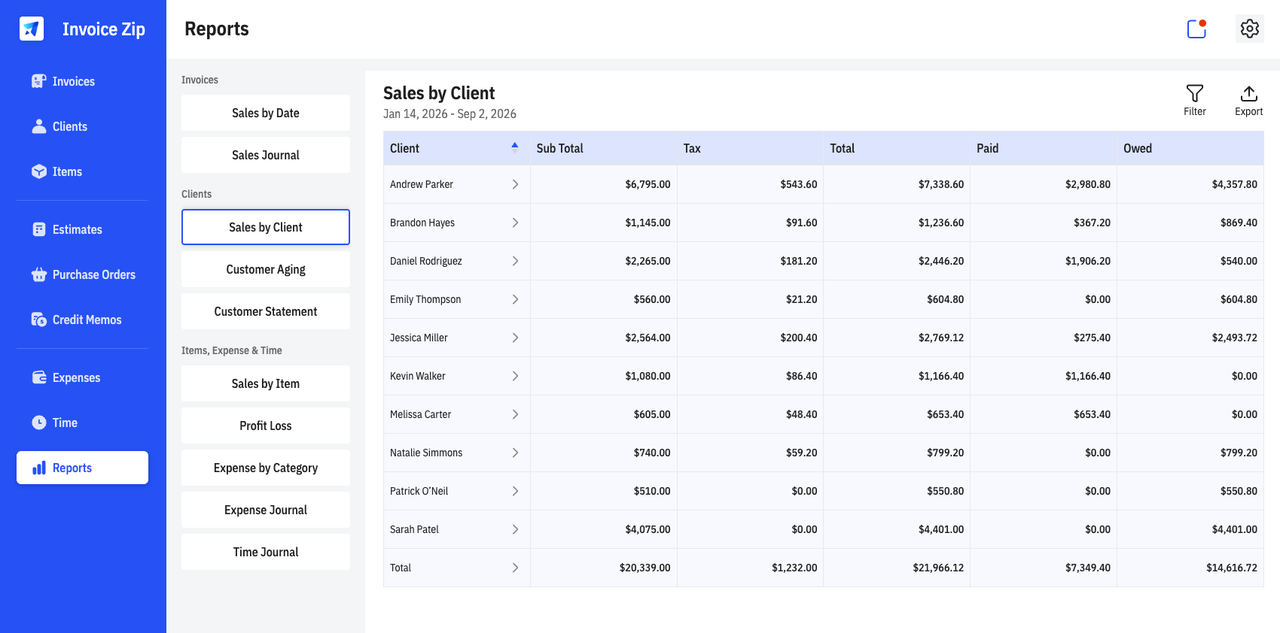
For example, you might see:
- Andrew Parker: $7,338.60 in total sales
- Sarah Patel: $4,401.00
- Daniel Rodriguez: $2,446.20
- Kevin Walker: $1,166.40
This immediately gives you a starting point for identifying your largest customers.
In this example, Andrew Parker has generated the most sales, followed by Sarah Patel. These customers may be worth looking at more closely.
But sales alone do not tell the whole story.
Look at the Customer's Invoice History
Once you find a customer with significant sales, you can look more closely at where those sales came from.
In the Sales by Client report, you can click More Details for a customer to see their invoice history.
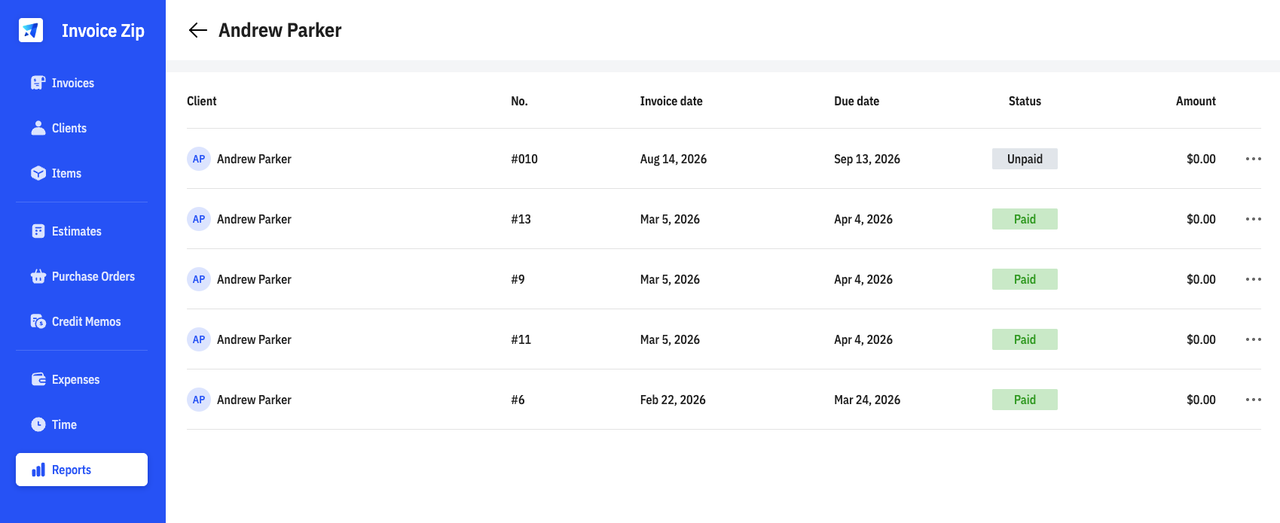
This gives you a more detailed view of the invoices associated with that customer.
For example, you may find that a customer's total sales came from several smaller invoices over time, while another customer's total came from only one large invoice.
That difference matters.
A customer who purchases from you repeatedly may represent an ongoing business relationship. A customer with one unusually large invoice may still be valuable, but the relationship may look very different.
You can use the invoice history to put the sales number into context instead of looking at the total by itself.
Compare Sales With the Amount Paid
Another useful number in the Sales by Client report is Paid.
A customer may have generated a large amount of sales, but that does not necessarily mean you have collected the full amount.
For example, imagine two customers:
- Customer A has $7,000 in total sales and has paid most of it.
- Customer B has $8,000 in total sales but still has a large amount outstanding.
Customer B has generated more sales, but Customer A may be contributing more to your current cash flow.
The Sales by Client report lets you see Total and Paid together, making it easier to spot this difference.
When comparing your customers, look at both numbers rather than ranking them only by Total.
This does not mean a customer with an unpaid balance is a bad customer. It simply gives you more information about the value of the sales you have generated and collected.
Check Outstanding Balances With Custom Aging
If you want to understand whether your most important customers still owe money, the Custom Aging report can give you another perspective.
Instead of looking at total sales, an aging report focuses on what is currently due and what has become overdue.
In Invoice Zip, Custom Aging shows customer balances along with amounts in different aging categories, such as Current Due, 1–30 Past Due, and 31–60 Past Due.
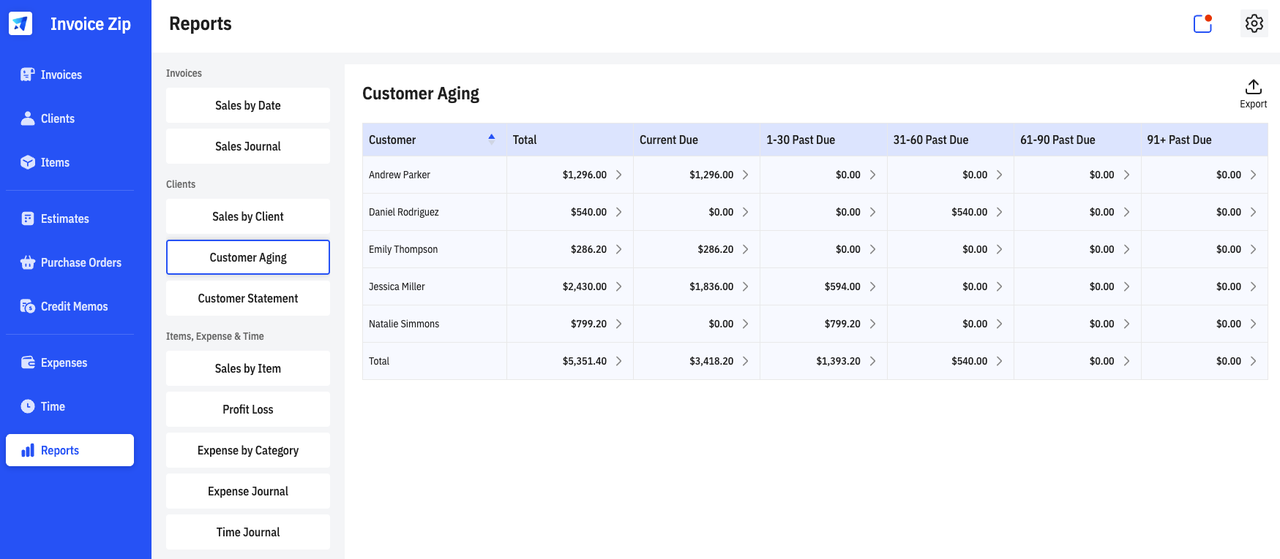
For example, you might see:
- Andrew Parker: $5,848.20 total due, including $1,296.00 currently due
- Daniel Rodriguez: $1,539.00 total due, including $540.00 31-60 past due
Now you can compare your sales data with your outstanding balances.
Suppose Andrew Parker is your largest customer by sales, but the Custom Aging report also shows a significant amount currently due. That does not change the fact that Andrew is an important customer. It tells you that there is also an outstanding balance that may need attention.
This is especially useful when a customer is both a major source of sales and a significant source of accounts receivable.
Follow Up With Important Customers
Identifying your most valuable customers is not only about ranking them. It can also help you decide where to focus your attention.
For example, you may want to maintain regular communication with customers who consistently generate a large amount of sales. If one of those customers also has an outstanding balance, you may want to follow up on the unpaid invoices.
A Customer Statement can help with that step.
In Invoice Zip, you can create a statement showing the customer's current invoice status and send it to the customer by email.
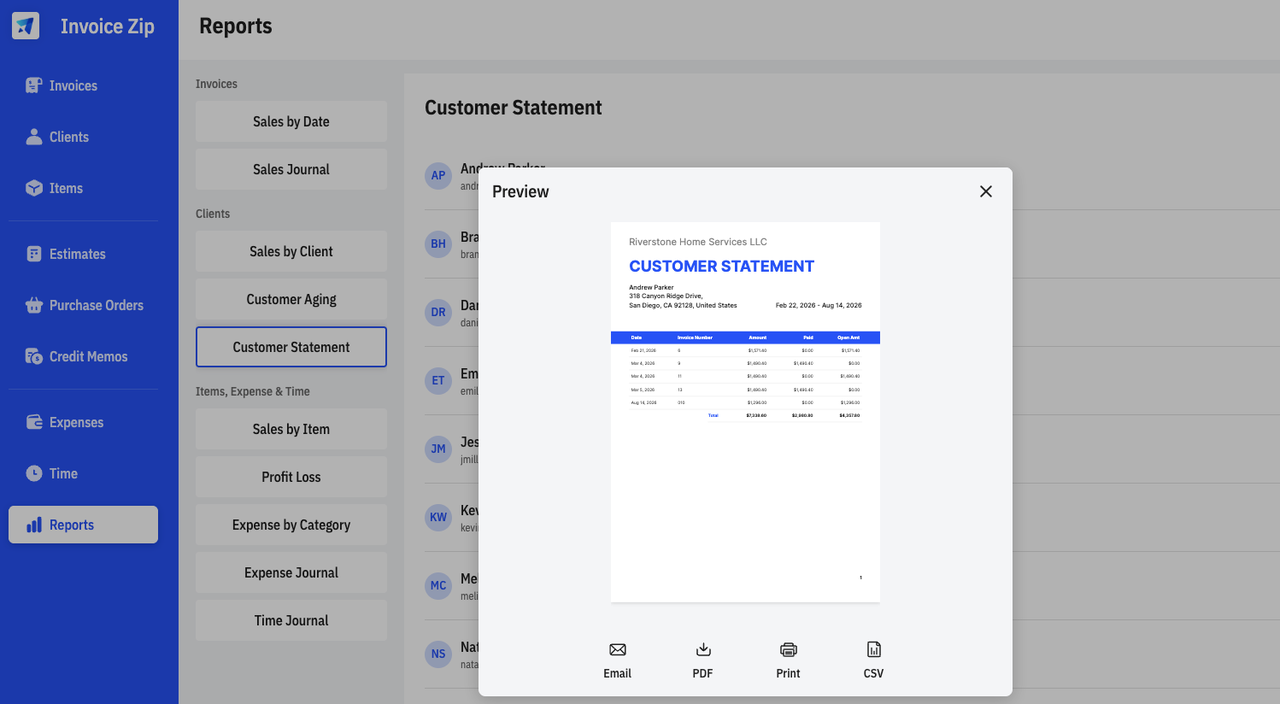
This is useful when you need to move from reviewing your customer data to taking action. Instead of manually explaining which invoices are still open, you can send the customer a statement with their current invoice information.
A Simple Way to Identify Your Most Valuable Customers
You do not need a complicated customer scoring system to start understanding which customers are most valuable to your business.
A simple process is:
- Compare sales by client. Use the Sales by Client report to see which customers generate the most sales.
- Review invoice history. Click More Details to see the invoices behind a customer's sales total.
- Check the amount paid. Compare Total with Paid to see how much of the sales has actually been collected.
- Check outstanding balances. Use Custom Aging to see whether important customers still have amounts due.
- Follow up when needed. Create a Customer Statement when you need to send a customer their current invoice status.
The customer with the highest sales is not always the customer who is most valuable to your business.
Looking at sales, payment, invoice history, and outstanding balances together gives you a much clearer picture. It helps you recognize the customers who contribute consistently, understand where your revenue comes from, and know when an important customer may need follow-up.
Most Popular Pages

Try Invoice Zip Today
Start Sending Invoices, Building Reports, Saving Office
Time and Get Paid Faster.