


IRELAND INVOICE TEMPLATES · EUR · A4
Free Irish Invoice Template
VAT Ready
No email required · No watermark · PDF, Excel & Word formats
Create Invoice Online
Enter your business, customer and line items. Apply one VAT rate to the whole invoice, or switch it off. Review your invoice as you type.
Create an Invoice
Fill in the fields — totals calculate as you type
1YOUR BUSINESS
2BILL TO
3ITEMS
4VAT
5DISCOUNT

6PAYMENT
Amount already received from the client
7NOTES & TERMS
One VAT rate applies to all items and is calculated on the subtotal after discount. Use an editable template when different items need different tax rates or treatments.
Your data stays in this browser — nothing is uploaded.
Sample details are fictional. Replace them with your own before sending.
Choose the Right Template for Your Situation
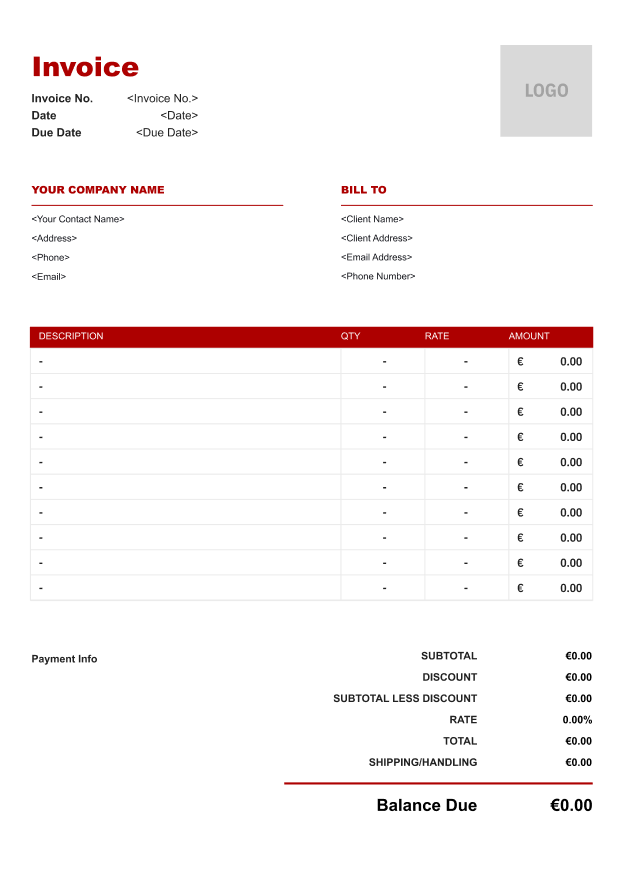


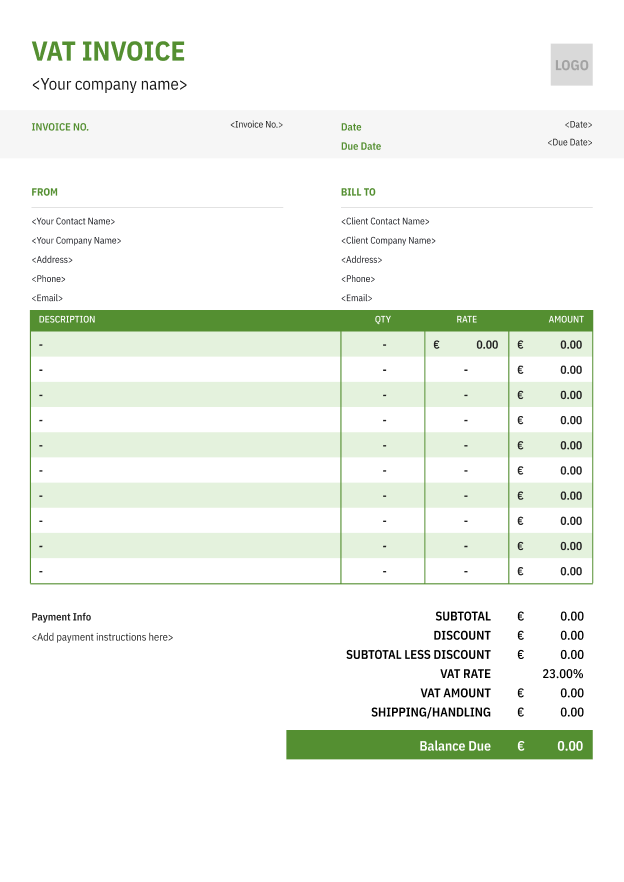
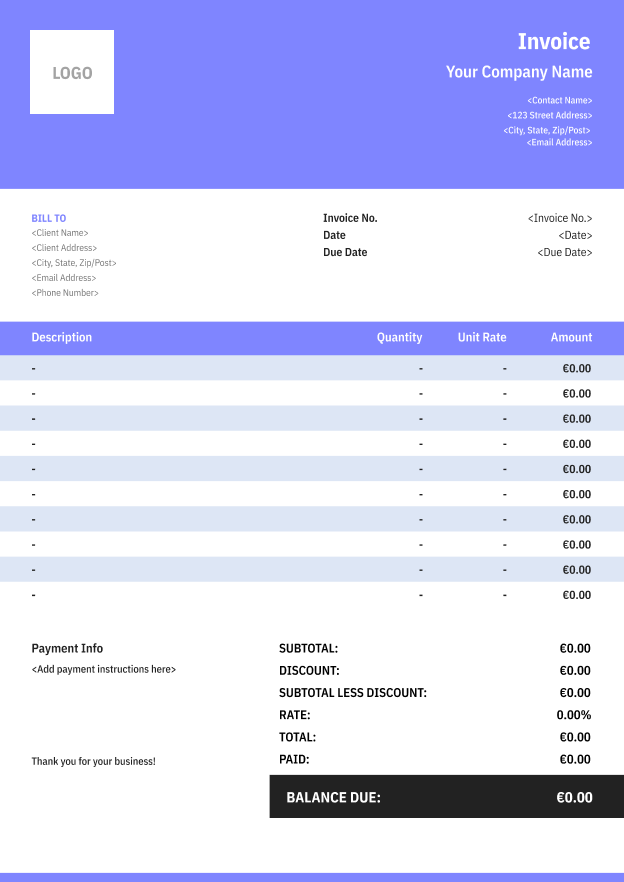
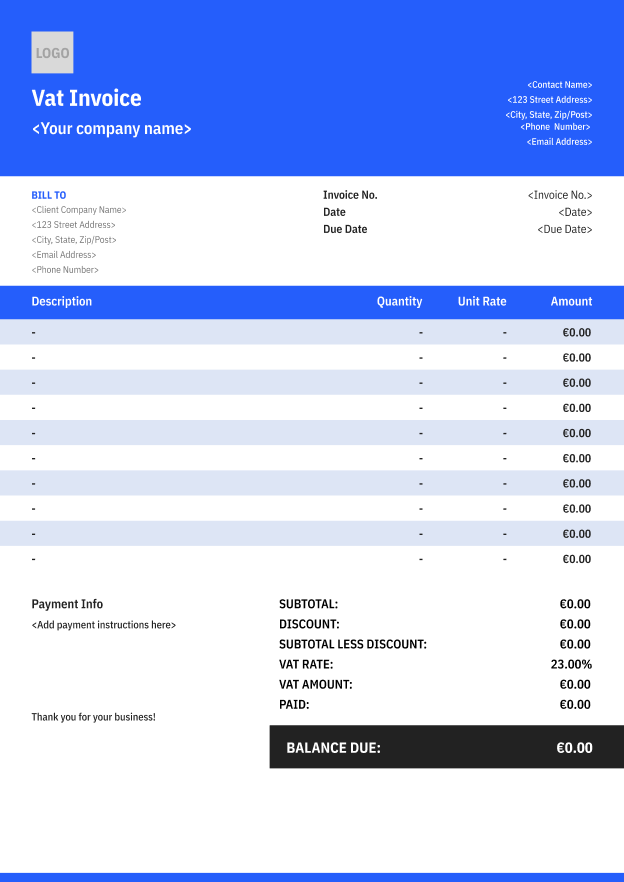
Fill It in Once. Reuse It Every Month.
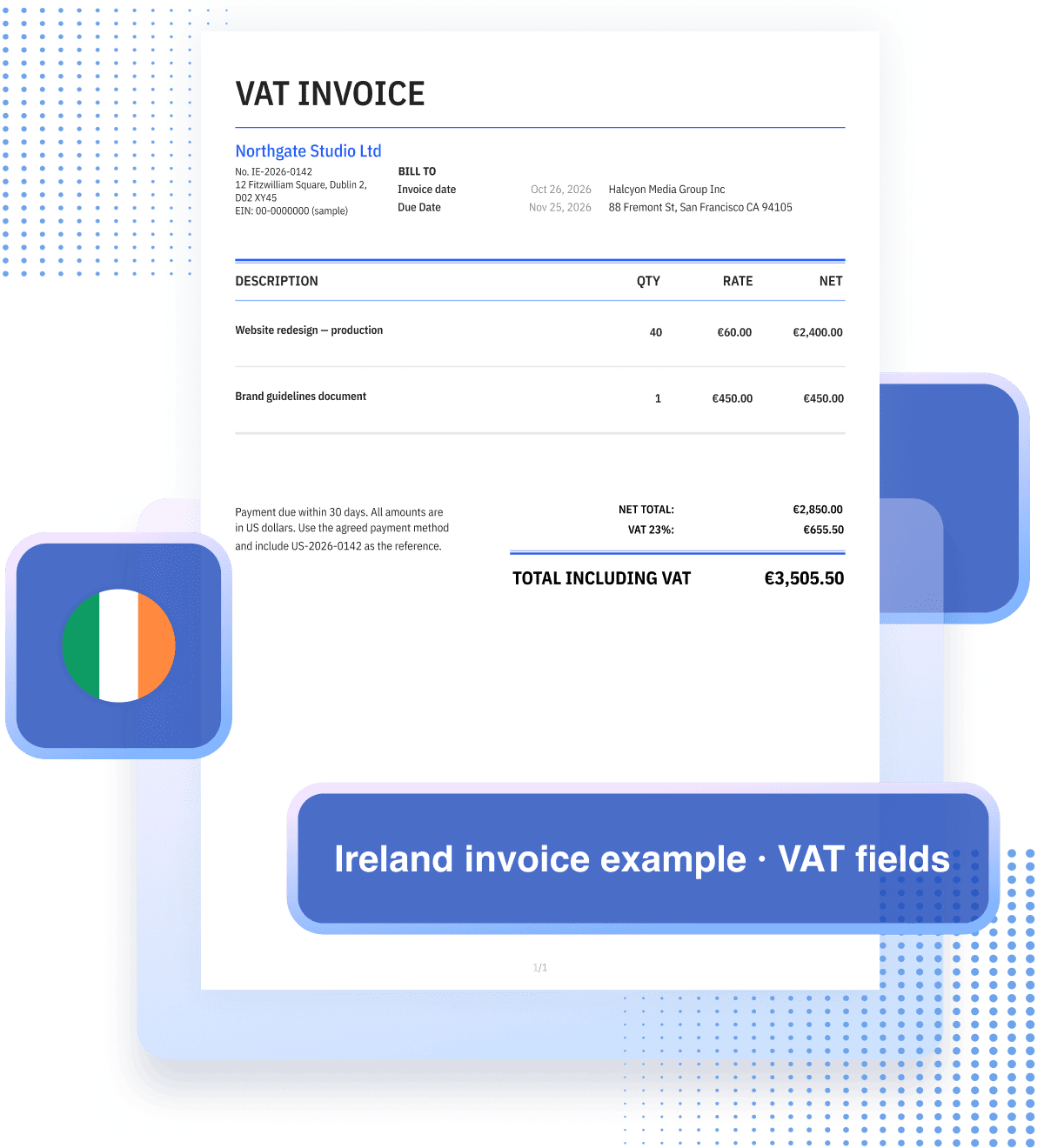
What an Irish VAT Invoice Should Include
- 1
Document Title
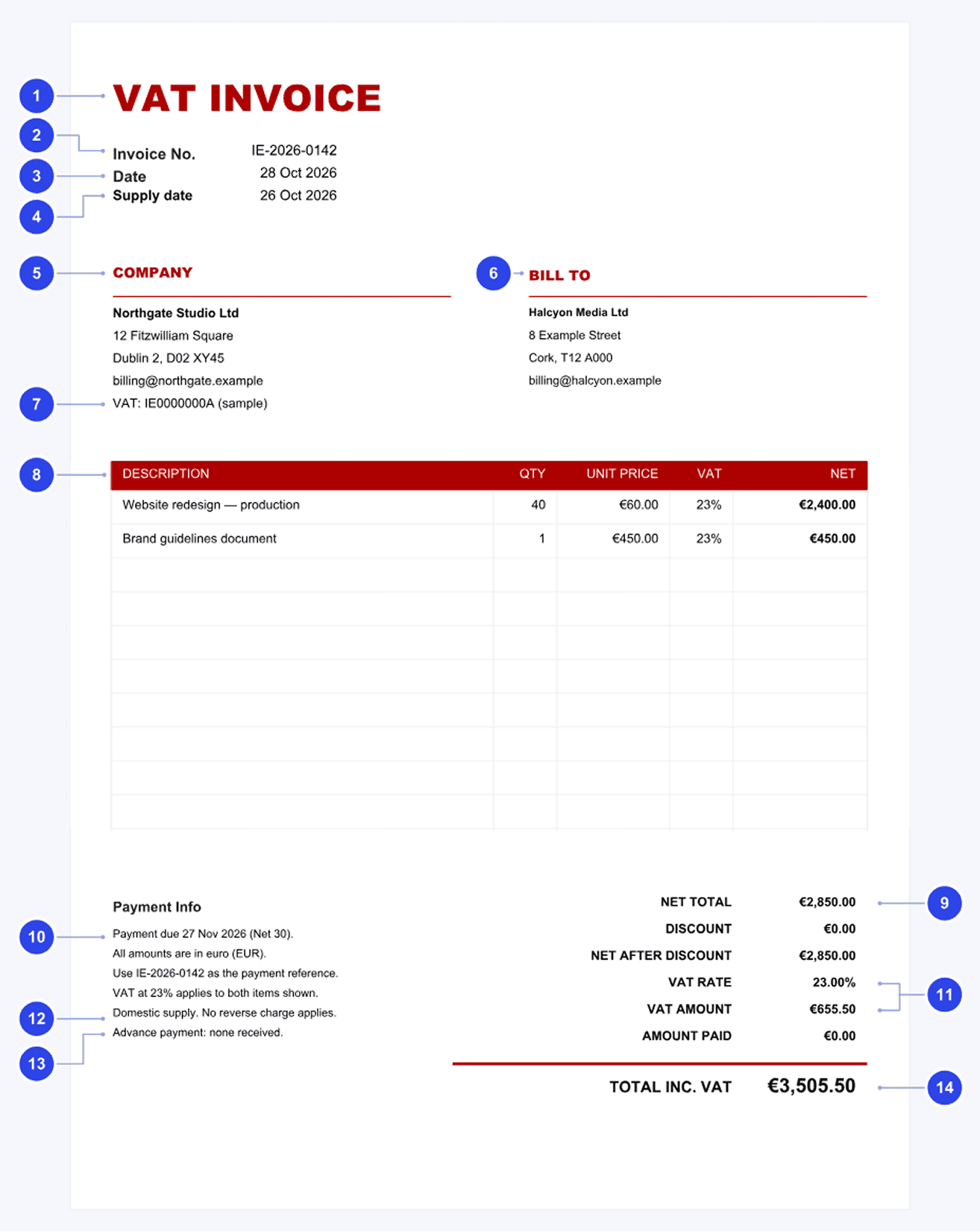
Use a clear heading such as “VAT Invoice” so the buyer can identify the document. The exact words are not a separate universal field in Revenue’s list of invoice requirements. A business that is not VAT registered should issue an ordinary invoice without charging VAT; a receipt and a pro-forma serve different purposes. - 2
Unique Sequential Invoice Number
Include a sequential number from one or more series that uniquely identifies the invoice, such as IE-2026-0142. Do not reuse a reference for a different bill. Keep records of corrections and any credit or supplementary invoices. - 3
Date of Issue
Record the day you issue the invoice. Keep it separate from the supply date and payment due date. A unique sequential invoice number is also required; it is shown separately at number 2. - 4
Date of Supply
Show the date the goods or services were supplied, identifying it separately when it differs from the issue date. Here, the supply date is 26 Oct 2026 and the invoice date is 28 Oct 2026. Advance-payment dates can also be needed when they differ from the invoice date. - 5
Supplier Name and Address
Show the supplier’s full business name and address, using details that identify the VAT-registered supplier. A sole trader can include their own name and trading name. Do not replace the address with only an email or website. - 6
Customer Name and Address
Identify the buyer using their full name and address. For a business customer, use the business receiving the supply rather than only a contact person. Add their VAT number when required for the transaction. - 7
Your VAT Number
Show the supplier’s correct VAT registration number. Irish formats include IE followed by seven digits and one or two letters, and an older format containing six digits and two letters. Do not assume every number has exactly eight characters after IE. IE0000000A here is an invalid sample placeholder. - 8
Description, Quantity and Price
Describe the nature and quantity of goods, or the nature and extent of services. Show the VAT-exclusive unit price and any discounts or price reductions. Hours, days or an agreed project scope can explain a service charge; “Services” alone gives little useful detail. - 9
Net Amount and Discounts
Show the VAT-exclusive charges and any actual discounts or price reductions. Keep the amounts separated by rate where more than one applies. The example has €2,850 net with no discount; a payment already received is not the same thing as a discount. - 10
Payment Terms and Details
Add the agreed payment due date, verified payment instructions and reference to quote. In this example, payment is due on 27 Nov 2026. These practical billing details do not replace the supply date or the invoice issue date. - 11
VAT Rate and Amount per Band
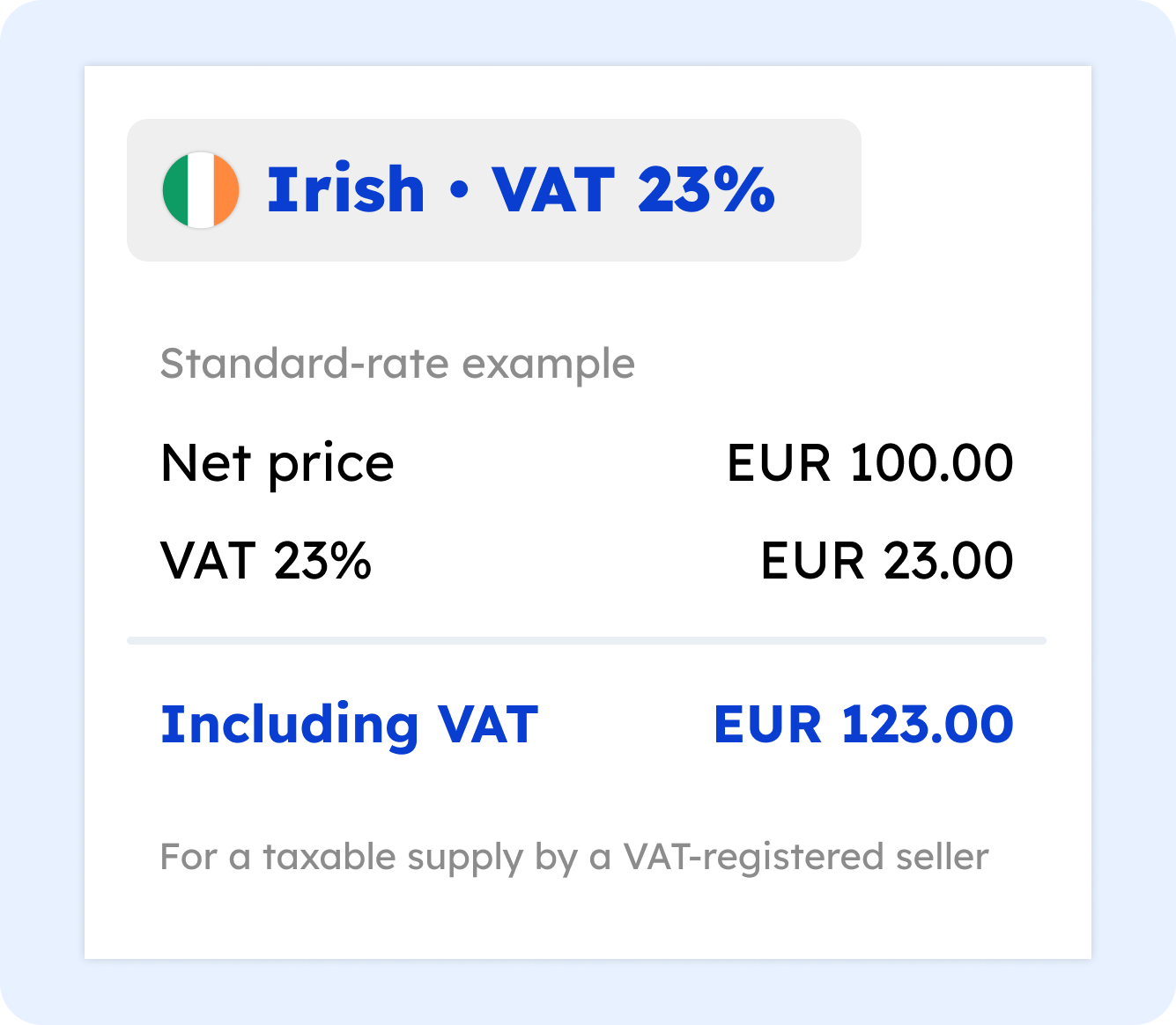
Break down the charges by the VAT rate applied and show total VAT payable. Ordinary rate bands include 23%, 13.5%, 9%, 4.8% and 0%, depending on the supply. Do not blend different rates. The domestic example applies 23% to €2,850, giving €655.50 VAT. Reverse-charge invoices do not display VAT payable. - 12
Reverse Charge Note
Where the reverse charge applies, state that it applies and include the customer’s VAT number where required. For qualifying general-rule EU B2B services, wording such as “Reverse charge — VAT to be accounted for by the recipient” is appropriate. Article 196 can be added where relevant, but citing it is not a universal extra requirement. The red domestic example correctly says no reverse charge applies. - 13
Advance-Payment Date, if Applicable
If payment is received before the supply, record the payment-on-account date when it differs from the invoice issue date. This example has no advance payment. In special cases, add any required tax-representative details or scheme wording in the relevant editable record. - 14
Invoice Total
Make the total amount payable clear and reconcile it with the net charges and VAT. Here, €2,850 plus €655.50 gives €3,505.50 including VAT. Show payments received separately so the outstanding balance is clear.
Irish VAT Rates and Registration Thresholds
Check Your Registration and VAT Treatment
Use your VAT registration details when issuing a VAT invoice. Check the supply and customer before deciding whether Irish VAT applies. A familiar template does not determine the correct rate or cross-border treatment.
- 01
Check the Registration Threshold
The principal annual thresholds are €42,500 for services and €85,000 for goods. The €85,000 threshold also covers qualifying mixed businesses with at least 90% goods turnover. Different rules apply to certain manufactured goods, acquisitions and other transactions. Revenue’s current guidance measures annual turnover excluding VAT in a calendar year.
- 02
Check Cross-Border Supplies
General-rule services to a business established in another EU state usually place the supply there and the customer accounts for VAT. Goods, land-related services and other exceptions need separate checks. The €10,000 EU distance-sales rule is a separate rule, not a universal VAT-registration threshold.
- 03
Keep VAT Records
Retain VAT records for at least six years, and longer where a particular rule or Revenue requires it. The usual VAT taxable period is two months, with other periods available where applicable. Retain invoices, corrections and relevant VIES evidence.
VAT Rate Reference
| Rate | Category | Typical supplies | Notes |
|---|---|---|---|
| 23% | Standard | Most goods and services, including many professional services, software and electronics | Applies unless a different rate or treatment is available. |
| 13.5% | Reduced | Many construction, repair and cleaning services; hotel accommodation | Specific rules and exceptions apply. Do not include all hospitality services in one band. |
| 9% | Second reduced | Qualifying restaurant/catering and hairdressing services from 1 July 2026; certain periodicals | Some drinks and other supplies remain at different rates. Newspapers generally fall in the zero-rate category, not this band. |
| 4.8% | Livestock | Certain qualifying livestock | Not a general agricultural rate; special rules apply to particular animals and transactions. |
| 0% | Zero-rated | Qualifying food, books, children’s clothing, newspapers and exports | Not every food or export qualifies. Keep evidence and check the conditions. |
| No VAT | Exempt | Qualifying medical, education, insurance, financial and residential-letting supplies | Different from outside-scope transactions; related input VAT is generally restricted. |
Check the official guidance:

Common Mistakes to Avoid
A Quick Review Can Prevent a Follow-Up

WRONG
 Charging Irish VAT to every EU business customer
- Assuming Article 196 must be quoted on every invoice
- Combining different VAT rates into one unexplained figure
- Using a customer VAT number without checking it
- Reusing the same number for a different invoice
- Description reads only “Services”
RIGHT
 For qualifying general-rule EU B2B services, charge no Irish VAT and state that reverse charge applies. Check exceptions first.
- Include the required reverse-charge wording when applicable. Add the legal reference where relevant; it is not an extra universal field.
- Show the breakdown by rate and the correct VAT payable for ordinary charged-VAT supplies.
- Validate the EU number, confirm the customer’s status and keep the evidence. Investigate an invalid result.
- Use unique sequential invoice references and keep a clear correction trail.
- Describe the actual work, its extent or quantity and its VAT-exclusive unit price.
Three Irish and EU Invoice Checks
- 01
Make Reverse-Charge Wording Clear
For qualifying EU B2B services under the general rule, include the customer VAT number and state that reverse charge applies. Do not display VAT payable. “Reverse charge — VAT to be accounted for by the recipient” is clear wording; Article 196 may be added where relevant. Intra-Community goods require their own conditions and notation.
- 02
Verify the Customer’s Business Status
Check an EU customer’s VAT number through VIES and retain the result with your records. An invalid result needs investigation: a new business may need a tax-authority letter while its number is pending. For a non-EU business, keep evidence of its business status and establishment. Do not rely only on the billing address.
- 03
Check the Rate and Effective Date
Do not assume every transaction is 23% or that all hospitality is 9%. Qualifying restaurant/catering and hairdressing services moved to 9% on 1 July 2026, while hotel accommodation remains at 13.5%. Newspapers generally qualify for 0%. Distinguish zero-rated, exempt and outside-scope transactions.