


NEW ZEALAND INVOICE TEMPLATES · NZD · A4
Free New Zealand Invoice Template
15% GST Ready
No email required · No watermark · PDF, Excel & Word formats
Create Invoice Online
Enter your business, customer and line items. Apply one GST rate to the whole invoice, or switch it off. Review your invoice as you type.
Create an Invoice
Fill in the fields — totals calculate as you type
1YOUR BUSINESS
2BILL TO
3ITEMS
4GST
5DISCOUNT

6PAYMENT
Amount already received from the client
7NOTES & TERMS
One GST rate applies to all items and is calculated on the subtotal after discount. Use an editable template when different items need different tax rates or treatments.
Your data stays in this browser — nothing is uploaded.
Sample details are fictional. Replace them with your own before sending.
Choose the Right Template for Your Situation
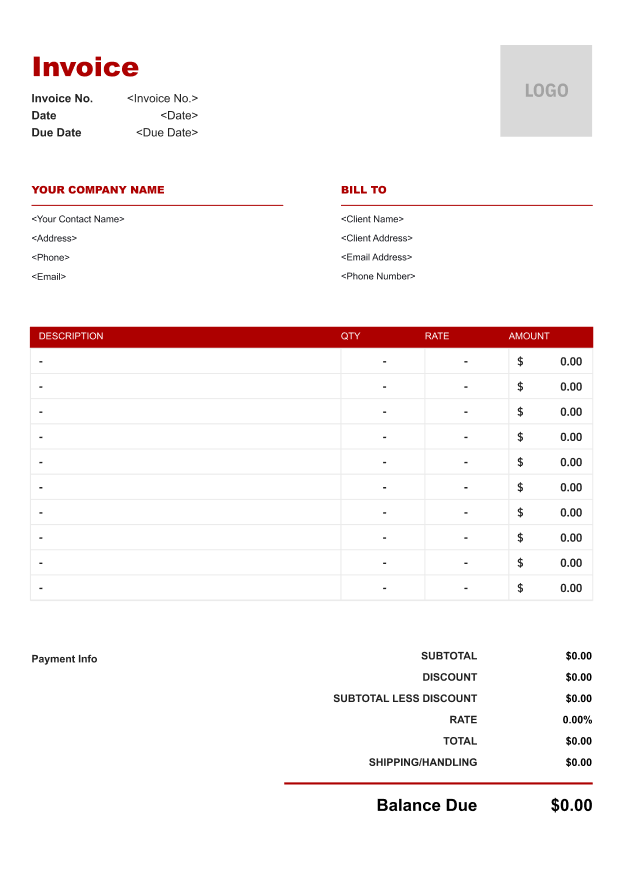


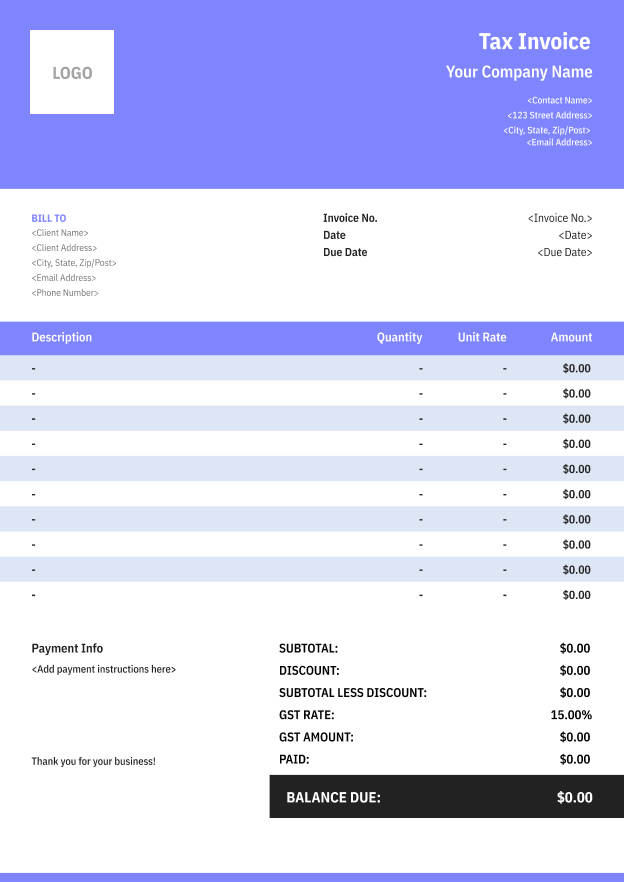
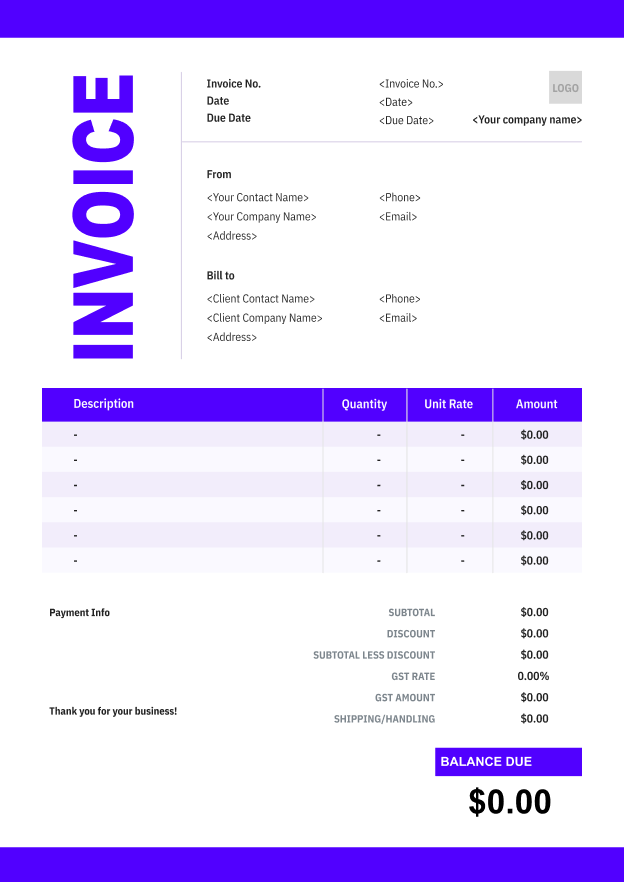
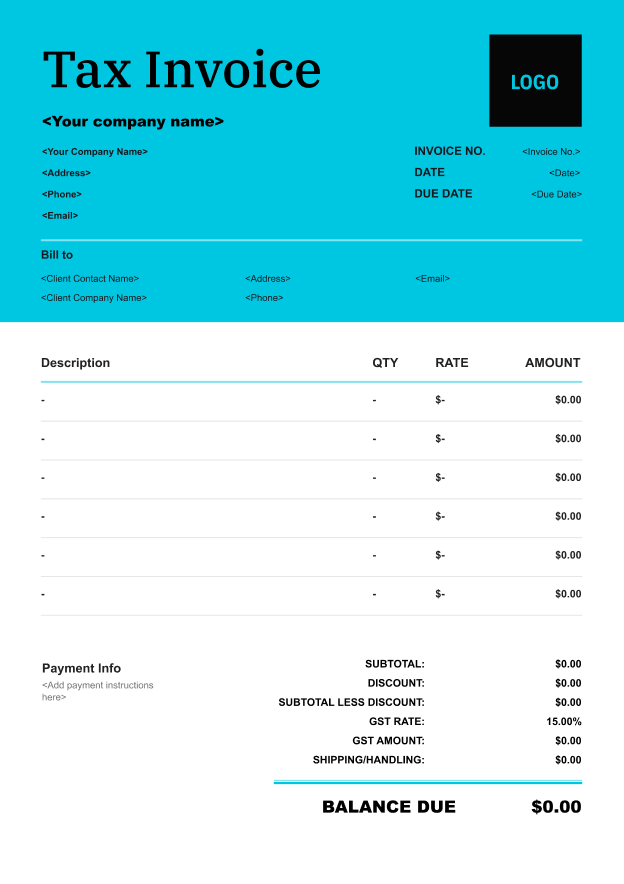
Fill It in Once. Reuse It Every Month.
What a New Zealand Invoice Should Include
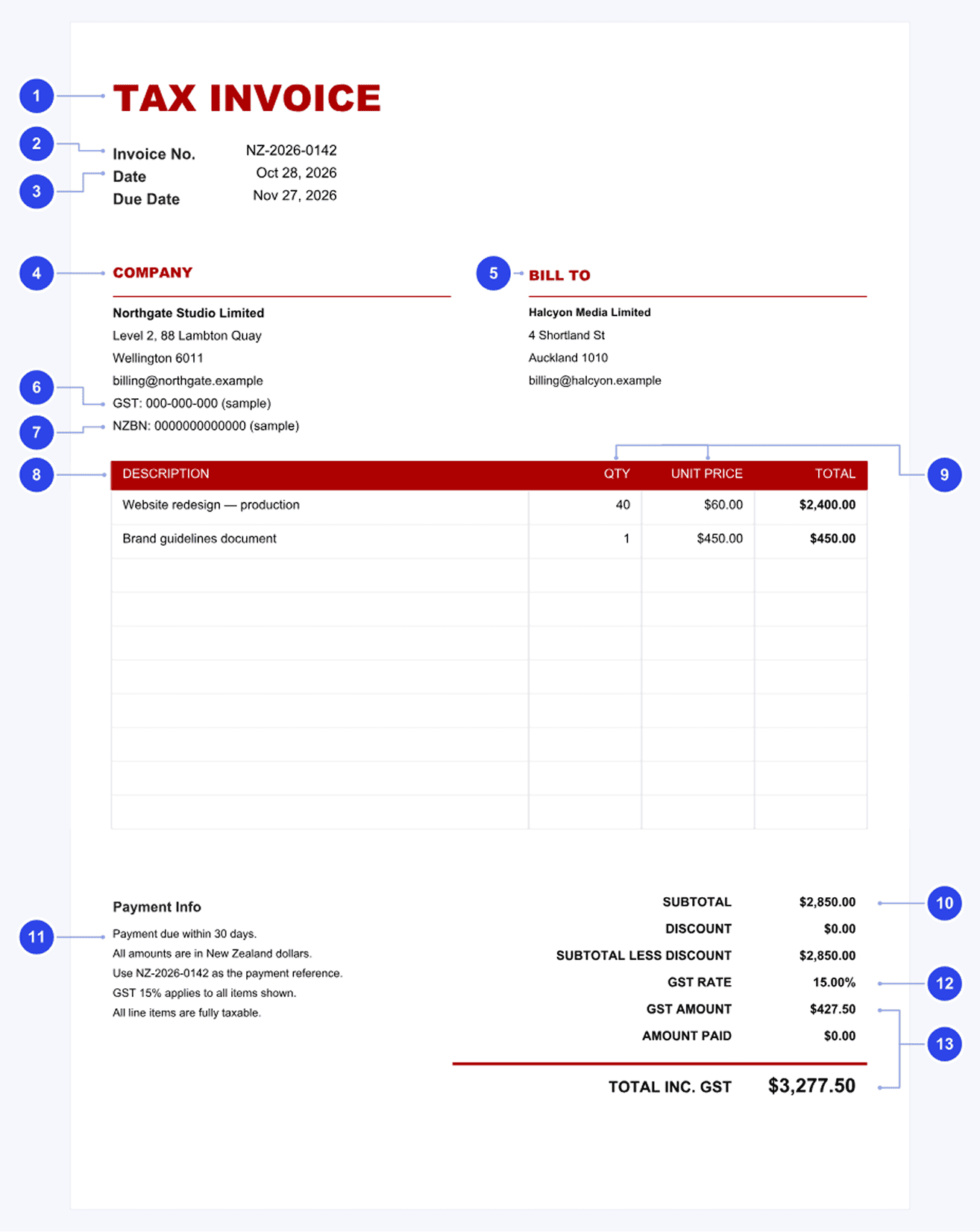
- 1
The Words “Tax Invoice”
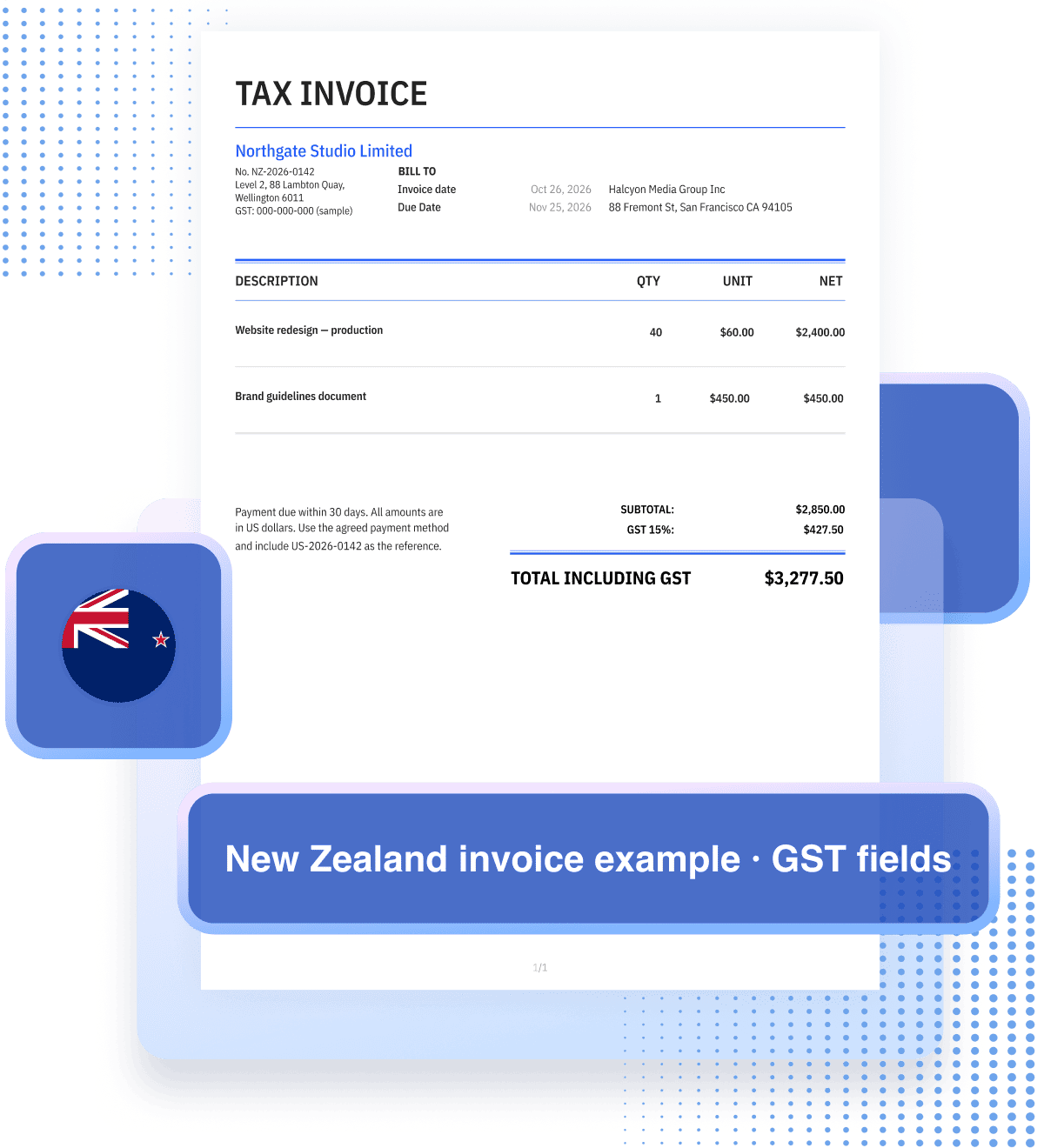
You may keep “Tax Invoice” as a clear document heading. Since 1 April 2023, that exact wording is no longer compulsory under the taxable supply information rules. The information you retain matters more than the title; this example is for a GST-registered seller. - 2
Invoice Number
Add a unique reference such as NZ-2026-0142 so the buyer can identify the bill and quote it when paying. It is a practical billing field, rather than a separate universal requirement in the ordinary taxable supply information table. Retain a record of corrections. - 3
Date of Issue
Record the invoice date, or the time of supply when no invoice is issued. Keep it distinct from the payment deadline. The GST return period also depends on whether you use the payments, invoice or hybrid accounting basis. - 4
Supplier Name and Address
Identify the seller by name or trade name. Add a contact address so the buyer knows who supplied the work. A sole trader may use their own name or trading name. An address is useful billing information, but it is not a universal requirement in the ordinary taxable supply information table. - 5
Buyer’s Name and Address
For ordinary supplies worth more than NZ$1,000 including GST to a GST-registered buyer, record the buyer’s name and at least one identifier. An address, email, phone number, different trading name, NZBN or website address can identify the buyer. A name and billing address are useful on other invoices too. - 6
Your GST Number
Show the supplier’s GST number for ordinary supplies over NZ$200. It has eight or nine digits, often displayed with hyphens. The sample 000-000-000 is a placeholder, not a valid registration. Your supplier NZBN does not replace your GST number. - 7
NZBN, if Used
An NZBN is a separate 13-digit business identifier. You may include your own NZBN as extra business information; it does not replace the supplier’s GST number. A buyer’s NZBN is one permitted buyer identifier when the higher-value information rules apply. - 8
Description of Goods or Services
Describe what was supplied clearly enough to identify it. For example, “Website redesign — production” with the quantity and price is more useful than a single unexplained entry reading “Services”. Keep supporting scope or delivery records where needed. - 9
Quantity and Unit Price
Show the number of items, hours or other agreed billing unit and its price. The example lists 40 hours at NZ$60 and one document at NZ$450. This detail explains how the charges were calculated and supports the description of the supply. - 10
Net Subtotal
Show the amount before GST and any actual discount. Check that the quantities, unit prices and net line amounts add up. In the example, NZ$2,400 plus NZ$450 gives a net subtotal of NZ$2,850. - 11
Payment Terms and Details
State the agreed due date, payment method and reference to quote. These are useful billing details, even though the ordinary taxable supply information rules do not prescribe a general payment deadline. Check bank details before sending. - 12
GST Rate
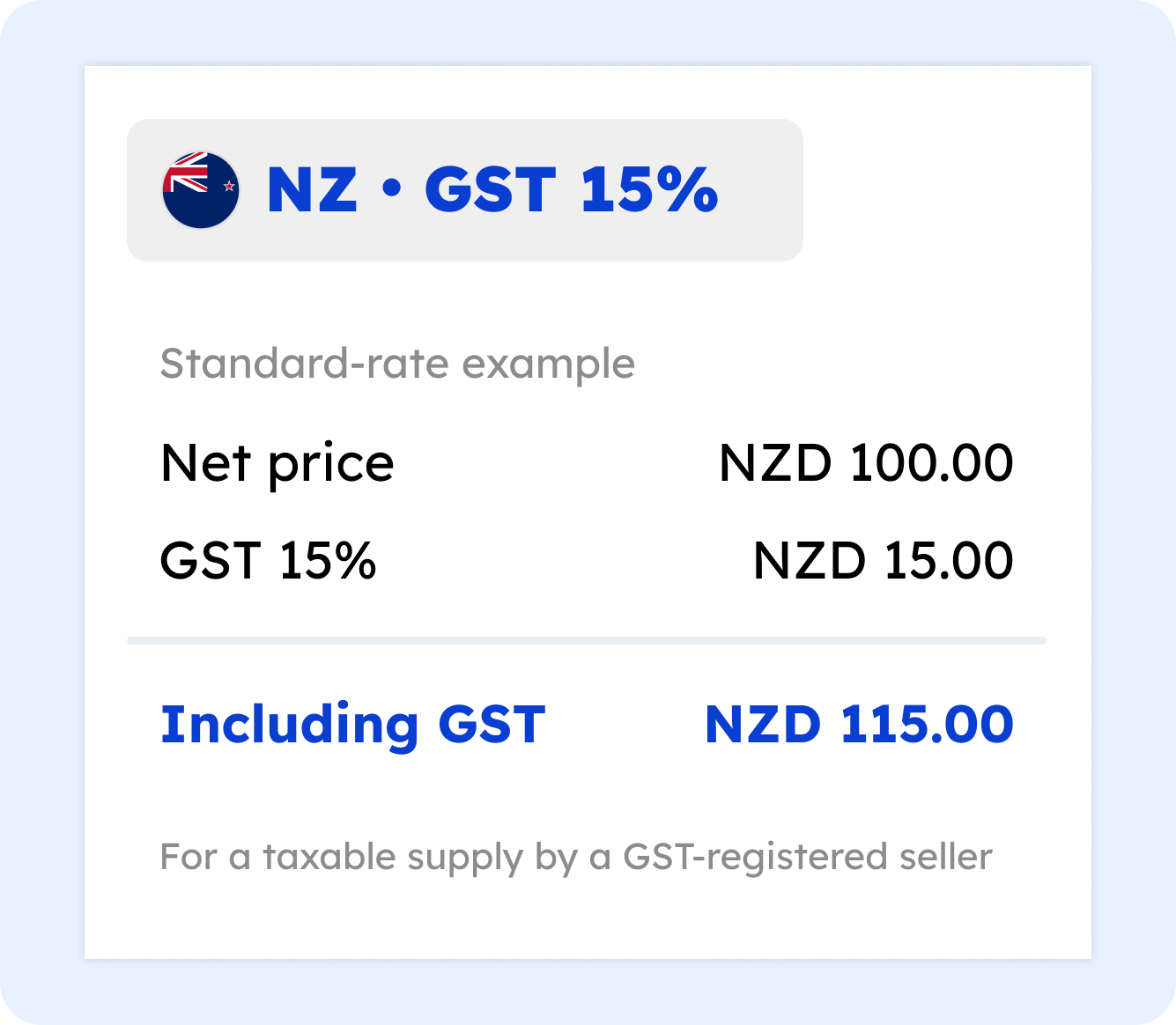
New Zealand’s standard GST rate is 15%. Apply the treatment that fits the supply and distinguish standard-rated, zero-rated and exempt items. Do not import the Australian 10% rate into a New Zealand invoice. - 13
GST Amount and the Total
Show the GST-exclusive amount, GST amount and GST-inclusive amount. Alternatively, for a supply charged at the standard rate for every item, show the inclusive amount and state that GST is included. This example uses NZ$2,850 net plus NZ$427.50 GST for a total of NZ$3,277.50.
New Zealand GST Rate and Key Figures
Check Your Registration and Records
A GST-registered seller normally charges 15% on taxable supplies. Use your GST number on the records where required; an NZBN is a separate business identifier. If you are not registered, use a regular invoice without GST.
- 01
Check the NZ$60,000 Threshold
You must register if taxable turnover was at least NZ$60,000 in the last 12 months or is expected to reach that amount in the next 12 months. Registration is also required if you carry on a taxable activity and add GST to your prices. Voluntary registration is available below the threshold.
- 02
Use Current Information Rules
The 2023 rules allow invoices and other records to work together as taxable supply information. Keep the seller name, relevant dates, description and payment information, then add GST and buyer details as the value and type of supply require.
- 03
Keep Records for Seven Years
Retain GST records for at least seven years. Filing may be monthly, two-monthly or six-monthly, depending on eligibility. Your payments, invoice or hybrid accounting basis determines when transactions are reported; the due date alone does not decide the GST period.
GST Rate Reference
| Rate | Category | Typical supplies | Notes |
|---|---|---|---|
| 15% | Standard-rated | Most domestic taxable goods and services | GST on related purchases may be claimable under the normal rules. |
| 0% | Zero-rated | Qualifying exported goods and services, going concerns and certain land transactions | Still taxable. Input GST may be claimable; eligibility and evidence requirements apply. |
| No GST | Exempt | Residential rent, many financial services and donated goods sold by non-profits | GST on related purchases generally cannot be claimed, subject to specific exceptions. |
Check the official guidance:

Common Mistakes to Avoid
A Quick Review Can Prevent a Follow-Up

WRONG
 Charging 10% GST because an Australian template uses it
- Treating the words “Tax Invoice” as the only test of valid records
- Showing only an NZBN instead of the supplier’s GST number
- Omitting buyer information on a NZ$1,200 sale to a GST-registered buyer
- Reusing a reference without keeping a correction trail
- Including GST in prices without explaining it
RIGHT
 Use New Zealand’s 15% standard rate for supplies that are taxable at that rate.
- Keep the required taxable supply information. The exact title is optional under the rules introduced in April 2023.
- Show your actual GST number where required. An NZBN is a separate identifier and does not replace it.
- For ordinary supplies over NZ$1,000 including GST, record that buyer’s name and at least one permitted identifier.
- Use unique invoice references and retain the relevant supply correction information.
- Show net, GST and inclusive amounts, or use the permitted inclusive-total statement when every item is standard-rated.
Three New Zealand Invoice Checks
- 01
New Zealand GST is 15%, Not 10%
New Zealand’s standard GST rate has been 15% since 1 October 2010. Australia uses 10%. If you trade in both countries, check the country, currency and applicable tax treatment rather than copying the rate from another template.
- 02
Separate Zero-Rated and Exempt Supplies
A qualifying zero-rated supply is taxed at 0%, and GST on related purchases may be claimable under the normal rules. An exempt supply is not charged GST, and related input GST is generally not claimable. Keep the reason and supporting evidence; an overseas address alone does not establish zero-rating.
- 03
Use the Current Value Thresholds
For ordinary supplies, the information tiers are NZ$200 or less, over NZ$200 up to NZ$1,000, and over NZ$1,000, including GST. The last tier adds buyer name and an identifier when the buyer is GST registered. “Tax Invoice” is still a useful title, but a rigid full-versus-abridged document format no longer describes the current rules.